

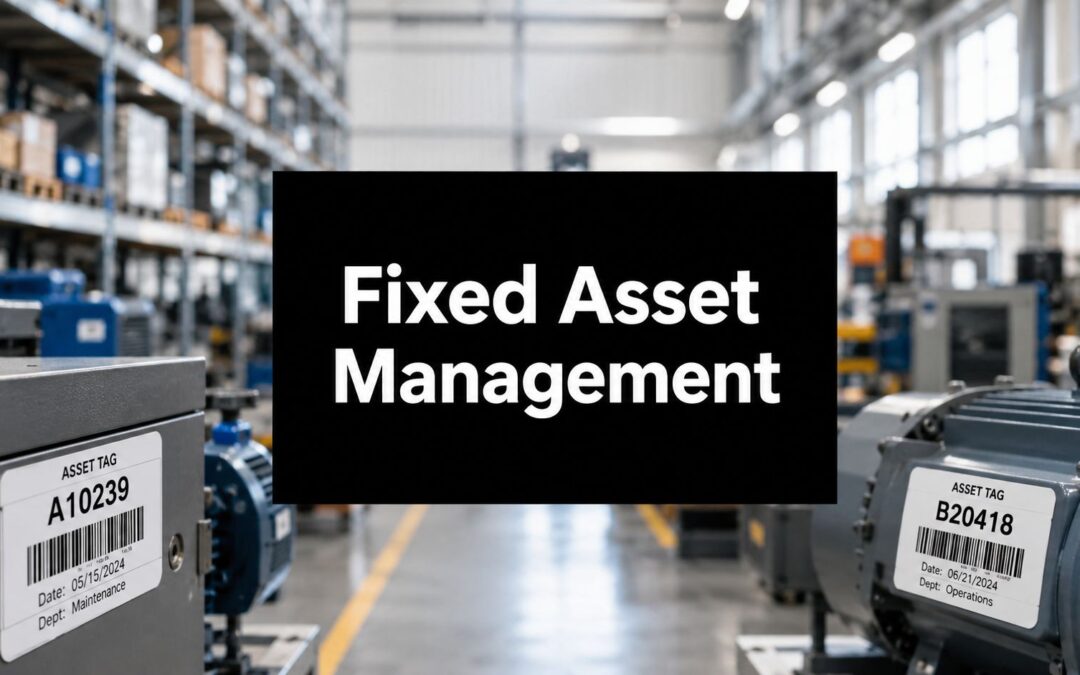
The audit list says the asset exists. The workshop team says they haven't seen it in months. Finance has a value assigned to it, maintenance has an old service note against it, and operations still assumes it's available if a breakdown hits the wrong line at the wrong time.
That's usually the moment people ask what fixed asset management is.
In industrial settings, the answer isn't “depreciation software” or “an asset spreadsheet”. It's the discipline of making sure every significant physical asset can be identified, located, maintained, audited, and retired in a controlled way. If the asset is on the books, someone should be able to prove where it is, what condition it's in, what work has been done to it, and whether it should still be in service.
The gap between a digital register and a real-world asset is where most problems start. Tags wear out. Equipment gets moved. Contractors service items off-site. One site uses one naming convention, another site uses a different one, and by year end nobody fully trusts the register. Good fixed asset management closes that gap.
The True Cost of a Missing Asset
An operations manager usually doesn't discover a weak asset system on a calm day. It turns up during an audit, a shutdown, a compliance check, or a maintenance scramble.
A common example is a portable but high-value asset that was purchased for one site, transferred to another, then parked in a storeroom, service bay, or contractor cage without the register being updated. On paper, it still looks controlled. In practice, nobody can put a hand on it. The search starts with calls, old spreadsheets, marked-up delivery notes, and a walkaround by people who should be doing other work.
The immediate problem isn't just the missing item. It's the chain reaction that follows.
- Operations loses time: Supervisors and technicians stop planned work to hunt for equipment.
- Finance loses confidence: The register can't be relied on if asset existence and location are uncertain.
- Maintenance loses context: Service history may sit against the wrong record, or not be linked at all.
- Compliance risk rises: Auditors want evidence that assets exist, are controlled, and can be reconciled.
The most expensive missing asset is often the one you technically still own but can't identify with confidence.
That's why fixed asset management matters. It prevents the situation where the books show ownership but the site can't show control. In factories, hospitals, utilities, councils, and infrastructure environments, that's not an administrative nuisance. It affects uptime, planning, and accountability.
The hard lesson is that missing assets rarely disappear in one dramatic event. Teams usually lose them by degrees. A relocation isn't recorded. A faded tag isn't replaced. A repair is done externally and the asset comes back with unclear identification. Over time, the register drifts away from reality.
Once that happens, every audit becomes a recovery exercise instead of a verification exercise.
Fixed Asset Management Beyond the Balance Sheet
Fixed asset management is the control system that links a physical asset to the information your organisation needs to manage it across its full life. That includes purchase cost, useful life, location, condition, maintenance history, and disposal status.
The narrow view treats it as an accounting function. The operational view is broader, and far more useful. It asks a simple question. Can finance, maintenance, and operations all look at the same asset record and trust that it reflects the actual item in the field?
The discipline has grown well beyond back-office use. The fixed asset management market analysis from Grand View Research states that the global market was valued at USD 264.68 billion in 2023 and is projected to reach USD 1,379.13 billion by 2030, with a CAGR of 28.3% from 2024 to 2030. That scale reflects a clear shift. Organisations now treat fixed asset management as a core operational capability, especially when assets are distributed across multiple sites.
A practical definition that works on site
For an operations manager, the easiest way to think about fixed asset management is this: every significant asset needs a reliable identity and a complete record.
That record should answer basic questions without guesswork:
- What is it
- Where is it
- Who uses or controls it
- What condition is it in
- What maintenance has it had
- When should it be replaced or retired
If any of those answers are missing, the system is weak.
Many teams describe the register as a kind of digital twin for the asset. That idea is useful, provided the physical side is solid. A digital record only helps if the actual pump, scanner, trolley, cabinet, device, or plant item can still be matched to that record in the field.
Why this matters in Australian operations
Australian industrial, healthcare, infrastructure, and government environments often deal with assets that are expensive, mobile, shared, or exposed to rough conditions. That creates a practical problem. The asset might exist, but if its label is unreadable, its location is stale, or its maintenance history is fragmented, it isn't under control in any meaningful sense.
Practical rule: If a technician can't identify the asset quickly and match it to the register, the data quality is already compromised.
This is why fixed asset management sits between finance and the floor. Finance needs the asset value and lifecycle record. Operations needs availability and traceability. Maintenance needs service history and condition context. A working system gives all three groups one version of the truth.
The Five Stages of the Asset Lifecycle
An asset doesn't become hard to manage at the end of its life. It becomes hard to manage when key information is missed at the start.

Acquisition
Control starts at purchase, not at the first audit. When an asset is acquired, the organisation should capture its core identity details straight away. That includes what was bought, when it was acquired, what it cost, who approved it, and how it should be classified.
This is also the point where teams often make their first mistake. They wait until deployment to create the record, which means the asset arrives before the system is ready for it.
Deployment
Deployment is where the asset moves from procurement into use. This is when it needs a unique identifier, an assigned location, a responsible team, and a confirmed operating context.
For many organisations, this is the stage where physical labelling should be finalised. If a site installs equipment first and plans to tag it later, later often doesn't happen properly.
Utilisation and monitoring
Once the asset is in service, the job changes from setup to control. Teams need to know whether the item is still where it should be, whether it's in use, and whether its recorded status matches reality.
A central register matters here. The InvGate guidance on fixed asset management software notes that a central fixed-asset register tracking purchase cost, useful life, service history, and disposal events is a core technical control, and that regular physical audits are typically performed annually to verify accuracy and eliminate ghost assets.
Maintenance and upgrades
Maintenance data is where lifecycle decisions become smarter. Service events, repairs, modifications, and upgrades should all feed back into the same record. Otherwise, maintenance history gets trapped in a separate system or in job notes that never influence replacement planning.
Teams that want a broader view of mastering asset reliability often find that lifecycle thinking works best when maintenance records and asset identity stay tightly linked.
Disposal
Retirement is not just removal. It's controlled closure. The asset should be marked as sold, scrapped, decommissioned, transferred, or otherwise disposed of, and the register should reflect that final status clearly.
If disposal isn't documented properly, the asset can stay on the books long after it has left the site. That's how ghost assets survive for years.
Technologies That Make Asset Tracking Possible
Software gets most of the attention, but fixed asset management only works when three things line up. You need a trustworthy register, a repeatable process, and durable physical identification.
The technology stack exists to support that combination. It doesn't replace the basics.

The register is the system of record
The historical change that mattered most in this field was the move from manual ledgers and periodic checks to software-enabled control. The NetSuite overview of fixed assets management describes this shift and notes that technologies such as barcodes, RFID, and GPS have become central to streamlining audits and reducing record errors in distributed settings.
A good register should hold enough information to support both finance and operations. Not every site needs the same fields, but most industrial teams need:
- Core identity data: Asset ID, description, serial number, model, and owner.
- Location data: Site, area, room, line, vehicle, crib, or field location.
- Lifecycle data: Acquisition details, status, maintenance history, and retirement record.
- Physical identification method: Barcode, QR code, RFID, engraved plate, or another durable marker.
In healthcare and similar controlled environments, teams often need software that supports location visibility, service scheduling, and audit readiness together. That's why many organisations look at specialised systems rather than forcing everything into a finance-only tool, especially in settings with mobile devices and compliance pressure. For a sector-specific example, this overview of healthcare asset management software shows the kind of requirements those environments commonly deal with.
Process is what keeps the data alive
A software platform can start clean and still decay fast if nobody updates it consistently. Moves, repairs, and status changes need a defined workflow. If those changes depend on memory or goodwill, the register will drift.
What works:
- Scanning during audits
- Updating records at handover
- Recording repairs against the correct asset ID
- Reviewing discrepancies immediately
What doesn't work:
- Tagging only high-profile assets
- Using temporary labels in harsh areas
- Leaving relocations to be fixed later
- Running audits without reconciling findings
The technology is only as strong as the routine around it.
A closer look at laser marking helps explain why the physical layer matters so much:
The physical tag is the bridge between software and reality
This is the part many articles skip. An asset register doesn't identify the asset. The tag does.
In harsh industrial environments, printed labels often fail first. Abrasion, cleaning chemicals, UV exposure, heat, moisture, and handling all take their toll. Once a code can't be scanned or a number can't be read, the link between the asset and the record starts to break.
That's why many operators use metal asset tags, anodised aluminium plates, or stainless steel labels with permanently marked data. Laser engraving is especially effective where long service life and legibility matter. Trotec Laser equipment is widely recognised for precise engraving on industrial tag materials, which is exactly what these environments need. Fine detail matters when you're marking compact QR codes, serial data, or tightly spaced identifier fields.
A durable tag doesn't make the process perfect. It does remove one of the most common failure points.
Best Practices for Industrial Asset Management
Most fixed asset problems aren't caused by a lack of software. They come from weak habits. Assets are purchased without a tagging standard, moved without a workflow, audited without reconciliation, and retired without register updates.
The strongest programs are usually simple. They define ownership, make identification durable, and insist that the register reflects the field.
What works in practice
The most reliable approach is to treat fixed asset management as an operating discipline, not an annual finance exercise.
- Set a site standard early: Decide what qualifies as a managed asset, what data must be captured, and who owns each step.
- Tag at the point of intake: Don't leave new assets unmarked while they wait for deployment.
- Pair verification with maintenance: The Bassets guidance on fixed assets management highlights a useful benchmark for mobile plant, electrical equipment, and healthcare devices. Pair periodic inventory verification with condition-based maintenance, and update the central register whenever assets are upgraded, repaired, relocated, or retired.
- Train for the why, not just the task: People follow scanning and update procedures more reliably when they understand how poor records create downtime, duplicate purchases, and audit issues.
A faded tag creates a data problem long before it creates an audit problem.
For teams responsible for broader fleet, plant, and site controls, practical guidance on asset tracking best practices can help shape a more durable process across departments.
Priorities change by industry
The core principles stay the same, but the operational pressure points differ.
| Industry | Primary Focus | Key Challenge | Recommended Tag Type |
|---|---|---|---|
| Manufacturing | Machinery uptime and service history | Assets operate in dirty, abrasive environments and may be modified over time | Engraved metal asset tags |
| Healthcare | Device location, service traceability, compliance readiness | Mobile equipment moves constantly across wards and service areas | Durable barcode or QR metal labels |
| Utilities | Control of distributed field assets | Equipment is spread across remote sites and exposed to weather | Weather-resistant engraved plates |
| Government | Security, accountability, and public property control | Assets move between departments, depots, and contractors | Tamper-evident engraved asset labels |
IT-heavy environments have their own complications around refresh cycles, disposal controls, and record discipline. Teams managing mixed fleets of hardware can borrow useful ideas from these Beyond Surplus ITAM insights, especially where chain of custody and status accuracy matter.
What to avoid
A few patterns repeatedly undermine otherwise decent systems:
- Shared naming with no standard: Different departments describe the same asset in different ways.
- Readable in office, unreadable on site: Label choices are made for convenience, not environment.
- Audit-only attention: The register gets cleaned up once a year, then neglected.
- No closure discipline: Retired assets stay active in the system because disposal workflows are weak.
Those are process failures, not software failures.
Measuring Success with ROI and KPIs
The business case for fixed asset management gets stronger when you measure operational outcomes, not just book values.
A good program should make the asset register more trustworthy, reduce wasted effort during audits, and support better maintenance and replacement decisions. Some of those gains are financial. Some are about risk control. Both matter.
KPIs that actually help
The most useful measures are the ones a site team can influence directly.
Asset register accuracy
Compare verified physical assets against the register after an audit cycle. This tells you whether your records reflect reality.Asset identification success rate
Track how often teams can immediately identify and scan assets during inspections, maintenance, or stocktakes. Low success usually points to poor tags, poor placement, or poor standards.Audit discrepancy rate
Measure how many exceptions appear during reconciliation, such as missing assets, wrong locations, duplicate records, or retired items still listed as active.Maintenance record completeness
Check whether service events are being linked to the correct asset records. If maintenance sits outside the register, lifecycle decisions get weaker.Utilisation visibility
Review whether teams can distinguish between assets that are deployed, idle, under repair, or ready for replacement.
How ROI usually shows up
Return on investment in fixed asset management often appears in places that were previously treated as unavoidable friction.
Better asset control improves replacement planning because teams stop making capital decisions with incomplete history.
In practice, the gains usually come from fewer search efforts, fewer duplicate purchases, better audit readiness, cleaner maintenance histories, and stronger evidence during compliance reviews. Sites also make better decisions about when to keep repairing an asset and when to retire it.
You don't need a complex formula to start. A practical review asks:
- What manual effort are we spending on finding, verifying, and correcting assets now?
- Where are poor records creating downtime, rework, or procurement mistakes?
- Which of those issues would improve if each asset had a durable identity and an accurate lifecycle record?

The exact numbers will vary by site. What matters is that the measures are repeatable, visible, and linked to actions people can take.
Your Fixed Asset Management Implementation Checklist
Most organisations don't need to start over. They need to tighten what they already have and close the gap between records and assets.
The first pass should be practical. Find what exists, decide what matters, and make sure each asset can stay identifiable in the conditions where it operates.
Planning and scope
Start by setting the boundaries. Not every item needs the same level of control, so decide which asset classes belong in the program and why.
Use this short checklist:
- Define the objective: Audit readiness, uptime support, compliance control, replacement planning, or a mix.
- Assign responsibility: Someone must own the register, but site teams must own updates in the field.
- Set minimum data requirements: Keep them strict enough to be useful and simple enough to maintain.
Data and physical identification
The success or failure of many rollouts hinges on asset identifiability. A digital register isn't enough if the asset can't remain identifiable through weather, chemicals, abrasion, cleaning, or heavy handling.
The GoFMX discussion of fixed asset management highlights this overlooked issue clearly. A critical part of the discipline is solving the operational gap between a digital register and the actual need for assets to remain identifiable across their lifecycle, especially in industrial environments.
For the physical side, tag selection should match the environment. In many industrial settings, engraved metal labels are chosen because they hold up better where printed labels tend to fail.
If the identifier won't survive the environment, the record won't survive the lifecycle.
Rollout and verification
Once the standard is set, rollout should be orderly rather than rushed.
- Audit what's already on site: Verify existence, current location, status, and condition.
- Apply unique tags consistently: Put them where technicians can scan or read them without awkward access.
- Load the register carefully: Bad starting data creates long-term confusion.
- Train staff by workflow: Receiving, maintenance, operations, and finance don't all use the system in the same way.
Review and optimisation
The first audit after rollout is the definitive test. It will show whether the process is easy enough for teams to follow and strict enough to maintain control.
Look for recurring issues:
- Unclear ownership of updates
- Assets with poor tag placement
- Records missing maintenance links
- Items relocated without status changes

A useful implementation doesn't aim for perfect data on day one. It builds a system people can keep accurate over time.
Evright Industrial helps Australian organisations close the gap between digital asset records and durable on-site identification. As a specialised division of Evright Industrial, backed by the engraving heritage of evright.com, the team produces industrial asset labels, safety signage, and permanent identification solutions designed for harsh environments where traceability has to last. If your current asset system looks fine on screen but falls apart on the floor, they can help you build a marking approach that works in practice.
Recent Comments