

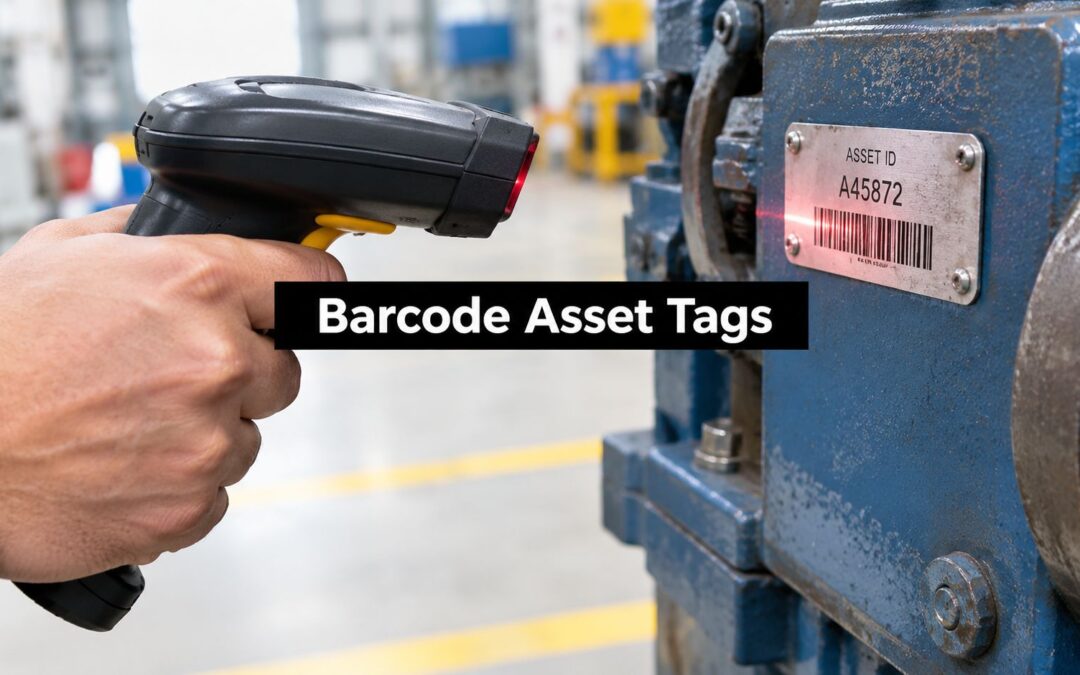
A technician is standing beside a washdown line during a maintenance audit. The machine is still productive, but its paper barcode has faded, curled at the edge and picked up a film of oil. The scanner rejects it repeatedly, so the technician types the asset number manually and hopes the register still matches the equipment in front of them.
That small failure can create a much larger operational problem. A barcode asset tag is the physical connection between a machine and its digital record, including ownership, inspections, maintenance history and compliance documentation. If the tag fails, the data bridge fails with it. In Australian conditions, choosing the right material and marking method matters far more than saving a little on the initial label order.
Why Cheap Asset Labels Fail in Harsh Environments
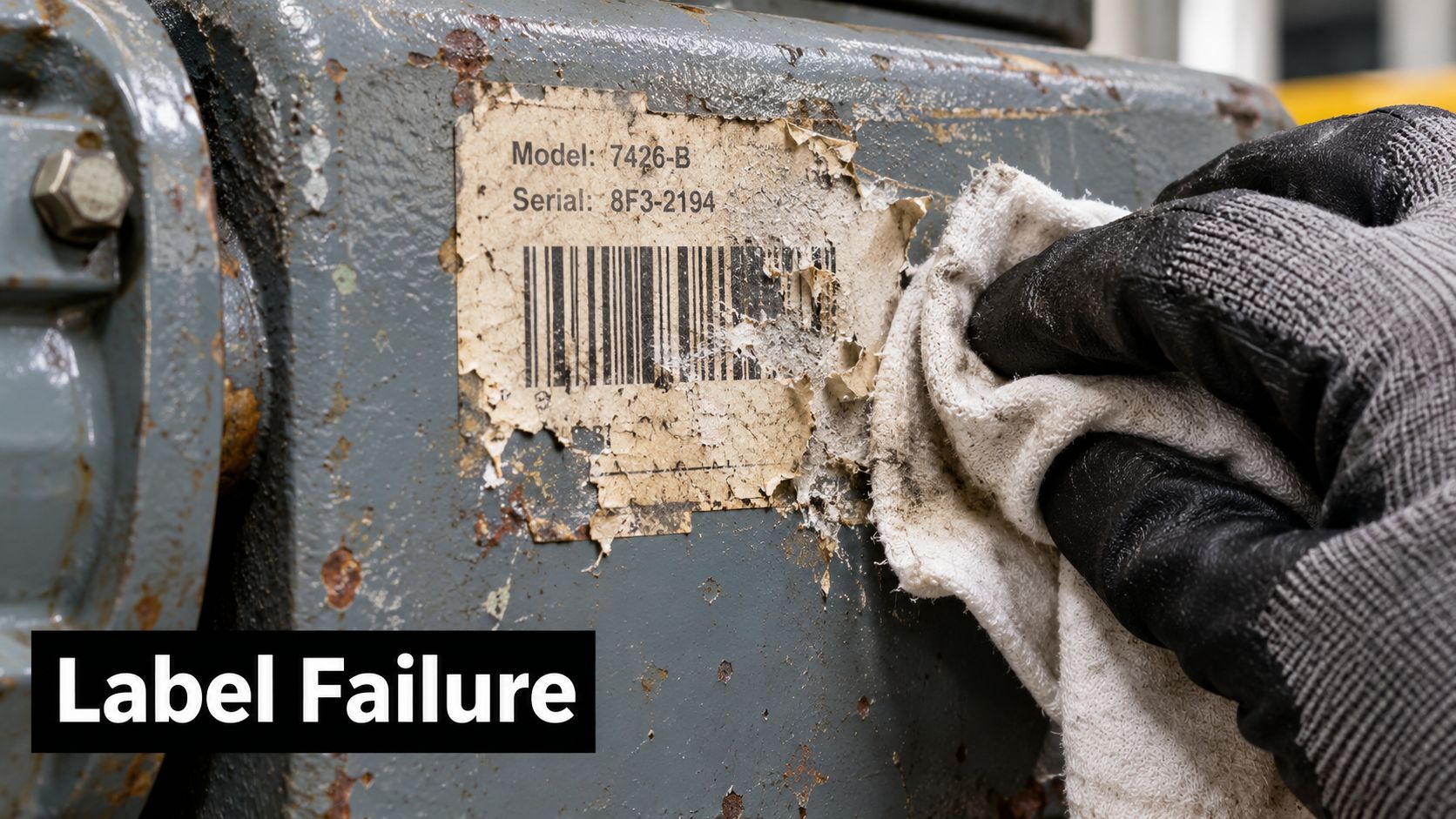
A maintenance audit can expose a label failure before anyone notices a machine fault. The barcode may still look acceptable from a distance, yet a scanner rejects it after months of sun, washdown chemicals, vibration and handling. The replacement cost is minor. The disruption to the asset register is not.
A cheap printed label often performs well at dispatch and poorly in service. Ultraviolet exposure fades the barcode, abrasion removes contrast, and solvents attack the printed face or adhesive. Repeated contact with gloves, tools and cleaning equipment lifts edges and creates damage that spreads across the code.
Paper and lightly protected print are poor choices for washdown areas. Water becomes more damaging when combined with alkaline cleaners, grease, heat and mechanical wiping. A lifted edge traps dirt. Scratches cut into the barcode's quiet zones. On a curved, rough or textured surface, the label can distort enough to make scanning unreliable.
Field rule: Specify the tag for the asset's full working environment, including cleaning, movement, inspection and audit conditions.
The hidden lifecycle cost appears in labour. Technicians search for serial numbers, compare photographs, reconcile duplicate records and correct maintenance entries by hand. An unreadable tag can delay an inspection, obscure ownership or make a maintained item appear unregistered. In a regulated operation, that uncertainty can affect traceability as well as productivity.
Australian health asset governance treats identification as a formal control recorded in the asset system at receipt, rather than an optional convenience. The same principle applies across industrial operations. A barcode asset tag must remain connected to the equipment record throughout the asset's working life.
Material selection should follow exposure, not the supplier's indoor label catalogue. For strong sunlight, salt air or outdoor service, use a substrate and marking method designed to resist UV and weathering. For washdown and chemical exposure, check adhesive compatibility and resistance to the actual cleaning products. For high-abrasion areas, specify a face that will not wear through during routine handling.
Laser engraving can provide a permanent mark on suitable metal or engineered substrates because the identifier is formed into the material rather than sitting only as surface ink. The trade-off is that the selected substrate, contrast and barcode geometry must suit the scanner and the available mounting area. A suitable industrial asset tracking label should be tested on the actual equipment and against its cleaning regime before a larger order.
Understanding Barcode Symbologies and Substrates
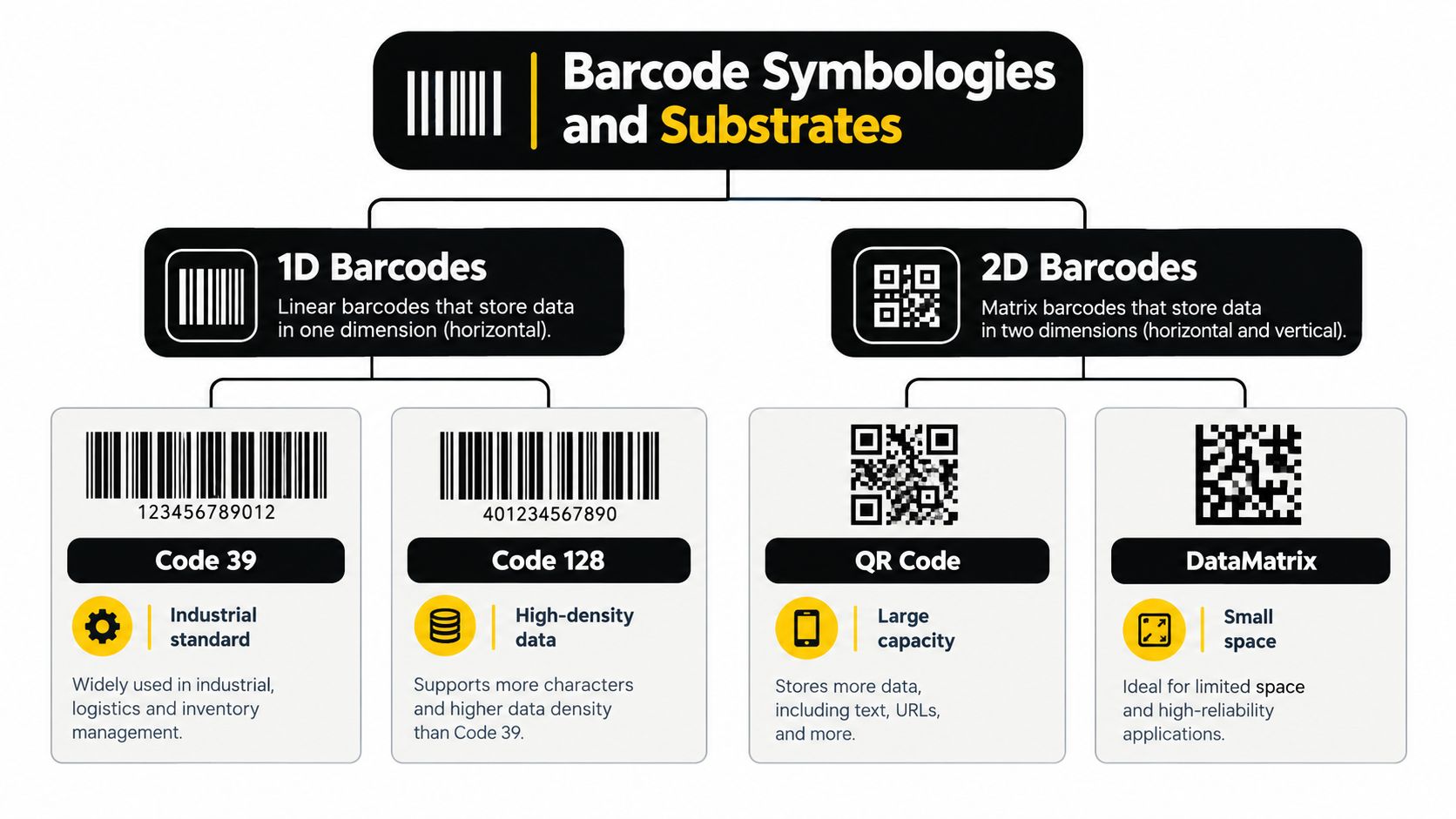
A barcode system has two separate engineering decisions. The first is the symbology, or the way data is represented. The second is the substrate and marking method that protect the code in the field. A well-designed code on a poor surface still fails.
Choosing between 1D, 2D and contactless identification
Traditional 1D barcodes remain practical for asset registers that use a short, unique identifier. Code 39 is familiar in industrial settings and works well where the tag has enough horizontal space. Code 128 packs data more efficiently and is often suitable when the asset number must fit on a smaller label. Both normally depend on line-of-sight scanning with a handheld reader.
A 2D code changes the trade-off. QR codes can hold more information in a compact area and are convenient where technicians use mobile devices. Data Matrix is useful where the available marking area is small, including compact metal plates and components with limited flat space. A damaged section of a 2D code may still be recoverable depending on the error-correction level and the extent of the damage, but it isn't a substitute for a durable face and clean contrast.
The GS1 128 label specification is a useful reference when a project has to follow structured logistics or identification conventions. For ordinary fixed-asset control, however, the best code is usually the one your scanner, software and maintenance team already support reliably.
RFID and NFC serve different operational needs. RFID can make sense where teams need to identify multiple items without individually aiming a scanner, or where line-of-sight access is consistently poor. NFC suits close-range interaction with compatible mobile devices. Neither technology removes the need for a human-readable identifier, a sound asset register or a substrate that remains attached and identifiable.
A barcode remains a strong default when assets are scanned one at a time, the workforce already carries handheld readers and the register needs a straightforward, low-friction identifier. Move to 2D when data density or mobile scanning is important. Consider RFID when the process depends on bulk or non-line-of-sight reading, and test the complete system before committing to a site-wide change.
Why the substrate controls scan reliability
Polyester and vinyl can work well for indoor industrial assets and moderate outdoor exposure, provided the face, adhesive and protective layer match the conditions. Anodised aluminium is better suited to fixed equipment where a long service life matters. 316 stainless steel is the more defensible choice around harsh chemicals, high heat, severe abrasion or aggressive cleaning.
Australian supplier guidance reports that polyester or vinyl labels with UV-resistant barcodes retain 98% readability after 12 months of outdoor exposure, compared with 65% for standard paper labels. The same asset-label material guidance maps polyester to indoor and moderate outdoor use, vinyl to outdoor assets with curved or flexible surfaces, anodised aluminium to long-life fixed equipment and 316 stainless steel to severe chemical, abrasion or heat exposure.
The code and the substrate must be specified together. A narrow Data Matrix on a warped label may be harder to scan than a larger Code 128 on a rigid plate. A high-contrast print may look excellent at dispatch but become useless after solvent wiping. Test the complete barcode asset tag on the actual surface, with the actual scanner and the actual cleaning process.
For inventory workflows, barcode labels for inventory should be designed around the register and scanning behaviour, not just the available label size.
Matching Materials to Australian Industrial Conditions
The right material depends on what attacks the tag. Outdoor UV, salt, washdown chemicals, oil, vibration, impact and heat don't affect every substrate in the same way. Procurement teams should specify the environment first, then select the label construction, adhesive and marking method.
Australian barcode suppliers report a long local history of asset identification, with one supplier stating that it introduced barcodes for asset management in Australia in 1982. A 2026 Australian equipment-tagging guide reports that 78% of Australian manufacturing facilities use standardised metal or anodised aluminium ID tags, with equipment misidentification incidents reduced by about 45% over five years. The same source reports that a 2024 industry estimate put equipment ID tag installations across Australian manufacturing, electrical and healthcare facilities at more than 2.3 million in a single year, with 67% incorporating barcode or QR technology. These figures point to a mature market where durable metal workflows are increasingly normal, not specialised.
Asset Tag Material Selection Matrix
| Material | Best Environment | Key Resistance | Expected Lifespan |
|---|---|---|---|
| Polyester | Indoor manufacturing, warehouses, healthcare equipment and moderate outdoor exposure | Good resistance when laminated, suitable for controlled industrial conditions and moderate UV | Practical outdoor life can be about 5 years for hard-laminated polyester constructions, depending on exposure and installation, as described in Australian asset-tagging guidance |
| Vinyl | Outdoor equipment, curved surfaces, flexible panels and council or utility assets | Flexibility, weather exposure and moderate outdoor use | Determined by UV load, cleaning, adhesion and surface movement |
| Anodised aluminium | Fixed plant, infrastructure, electrical equipment and long-life identification points | UV, abrasion and permanent surface marking | Long-life option for fixed equipment, with service life governed by the asset environment |
| 316 stainless steel | Mining, chemical processing, washdown zones, high-heat assets and severe industrial cleaning | Chemicals, corrosion, abrasion, impact and heat | Long-life option for severe duty cycles, subject to attachment and surface conditions |
Polyester is often the sensible choice for indoor plant rooms, office equipment and areas where the label won't face aggressive cleaning. Vinyl earns its place where a tag must conform to a curved surface or flex with the asset. Neither should be treated as a universal answer for a mine site, exposed utility infrastructure or a high-temperature production line.
Anodised aluminium is a strong choice for fixed equipment because the marking becomes part of the treated metal surface rather than relying on a thin printed film. It suits switchboards, pumps, cabinets, structural equipment and other assets that need a durable identifier without the weight and cost of a heavier stainless plate.
316 stainless steel is the conservative selection where failure is difficult to tolerate. Chemical exposure, abrasive cleaning, salt, heat and impact can quickly expose the weaknesses of cheaper polymers. Metal isn't automatically better, though. It still needs a suitable attachment method, a flat marking area and a design that leaves the barcode large enough for reliable scanning.
The cheapest label is rarely the lowest-cost option if technicians must re-identify equipment, interrupt production or re-tag an asset after a cleaning cycle.
A practical selection process should record the asset location, surface type, temperature, cleaning chemicals, outdoor exposure, expected handling and required service life. For mining, utilities and council fleets, include mud, dust, rain, vibration and impact. For healthcare, include disinfectants, frequent wiping and the need for clear, auditable identification. For manufacturing, include oils, solvents, heat and routine maintenance contact.
Installation and Surface Preparation Best Practices
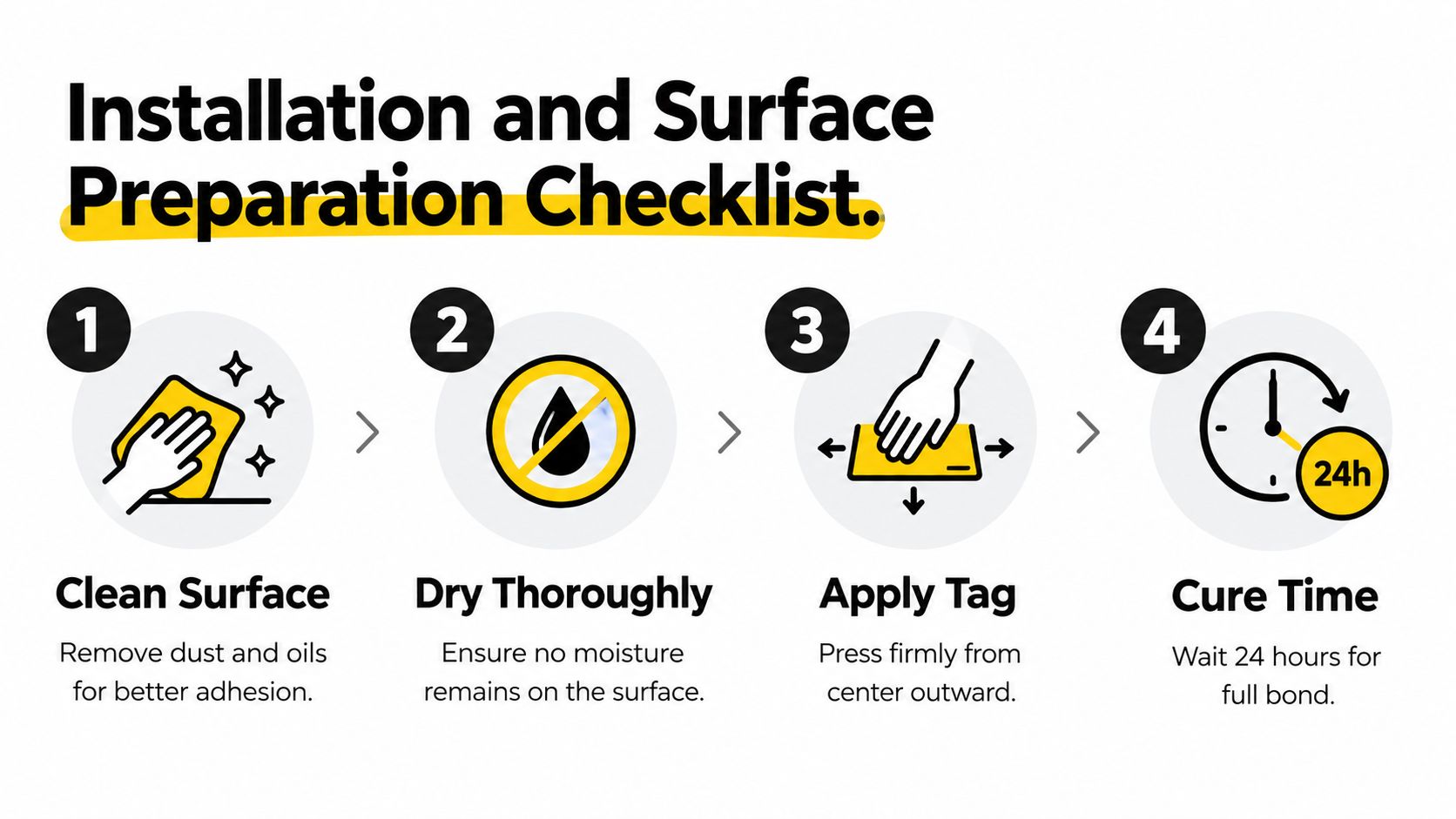
Even a well-made stainless steel tag can fail when it's bonded over oil, dust or condensation. Installation is part of the specification, and maintenance teams should treat it as a controlled field task rather than a quick sticker application.
Prepare the surface before the tag arrives
Choose a sound location. Select a flat area with clear scanner access, away from sharp edges, hinges, handles, drains, high-friction contact points and surfaces likely to be replaced during maintenance. Keep the barcode visible without requiring a technician to reach into a hazardous position.
Remove contamination. Clean away grease, oil, dust, rust scale and old adhesive using a method compatible with the asset surface. Oily manufacturing equipment usually needs solvent cleaning, followed by a clean wipe. Don't apply a label over a residue that will prevent the adhesive from wetting the surface.
Dry completely. Moisture trapped under the tag weakens the bond and can encourage corrosion or edge lift. Outdoor equipment may look dry while retaining condensation in seams and textured areas, so allow the surface to stabilise before application.
Manage texture. A heavily textured or rough surface may need light abrasion, mechanical attachment or a different tag design. Don't force a rigid plate onto a surface that prevents full contact. The barcode must also remain flat enough for the selected scanner and symbology.
Apply for reliable scanning and adhesion
Peel the liner without touching the adhesive, align the tag carefully and press from the centre outward to remove trapped air. Apply firm, even pressure across the full face and edges, especially where vibration could work under the perimeter. For metal plates, use the specified fasteners or adhesive system rather than improvising with general-purpose glue.
Place the code where a technician can scan it from a safe, natural stance. Avoid positioning it behind guards, beneath removable covers or on a face that becomes inaccessible during normal inspection. If the asset has several service points, choose one standard location and record that convention in the work instructions.
Installation check: Scan the tag immediately after application, then confirm that the returned identifier matches the asset register. A successful scan of the wrong number is still a failure.
Keep newly applied adhesive away from water, solvents and heavy handling until the supplier's bond-development requirements have been met. Record the tag identifier, location, installer and date in the asset system. This creates an installation trail and gives the maintenance team a reference if a tag later needs inspection.
A small sample trial is worthwhile before a large rollout. Apply the proposed barcode asset tag to representative painted steel, stainless steel, plastic and textured surfaces, then expose the samples to the same cleaning and handling routine used in the facility. The result should be judged by scan reliability, edge condition and register accuracy, not appearance alone.
Compliance and Digital Asset Register Integration
A barcode asset tag earns its keep only when it points to a controlled, accurate record. That record should contain ownership, location, maintenance history, inspection status and supporting documents. Keep those details in the register rather than crowding them onto the physical identifier. A low-cost label that scans to the wrong record, or to no record, creates repeat searches, incorrect work orders and avoidable replacement work over the asset's life.
Queensland Health provides a clear example of this principle. Its Single Asset Identifier guideline requires financial assets and maintainable items to receive a SAID number barcode label, record that identifier in the relevant asset system and affix the label upon receipt. It also specifies white labels for financial assets and yellow labels for maintainable items, linking the barcode process to compliance reporting under the Financial and Performance Management Standard 2019. The Queensland Health asset identification guideline shows how colour, ownership, maintenance responsibility and financial control can operate through one standardised scheme.
Build the scan into the work process
A technician should scan the tag and reach the correct asset record without sorting through similar equipment. Configure the system to reject duplicate identifiers, retain history when equipment moves and distinguish an inactive asset from an unregistered one. If a damaged label is replaced, retain the old identifier, replacement reason and date so the asset history remains auditable.
Sequential numbering with Code 39 or Code 128 is common for barcode asset tags. Linked to asset-management software and handheld readers, the code gives field staff a quick machine-readable key while the register stores the maintenance and inspection detail. The asset label printer guide explains how numbering and barcode formats fit into asset registers and maintenance workflows.
Safety identification follows the same control principle. Australian safety-tag guidance states that serial numbers, asset register numbers, barcodes, QR codes or RFID can track maintenance, inspection records, ownership and accountability across the equipment lifecycle. It also states that paper tags and handwritten labels are not acceptable under AS/NZS 4836 and broader WHS practice, as outlined in this safety-tag guidance for equipment identification.
Governance principle: The tag identifies the asset, the register controls the record and the work process proves that people used both correctly.
A useful data governance approach in CMMS should assign responsibility for creating identifiers, amending records, approving transfers and closing out failed or replaced tags. Define the minimum scan test before an asset enters service, and record exceptions rather than allowing technicians to work around them. This keeps a tidy tagging project from producing an unreliable database and preserves the evidence needed for audits, maintenance decisions and future label replacement.
The Advantage of Precision Laser Engraving
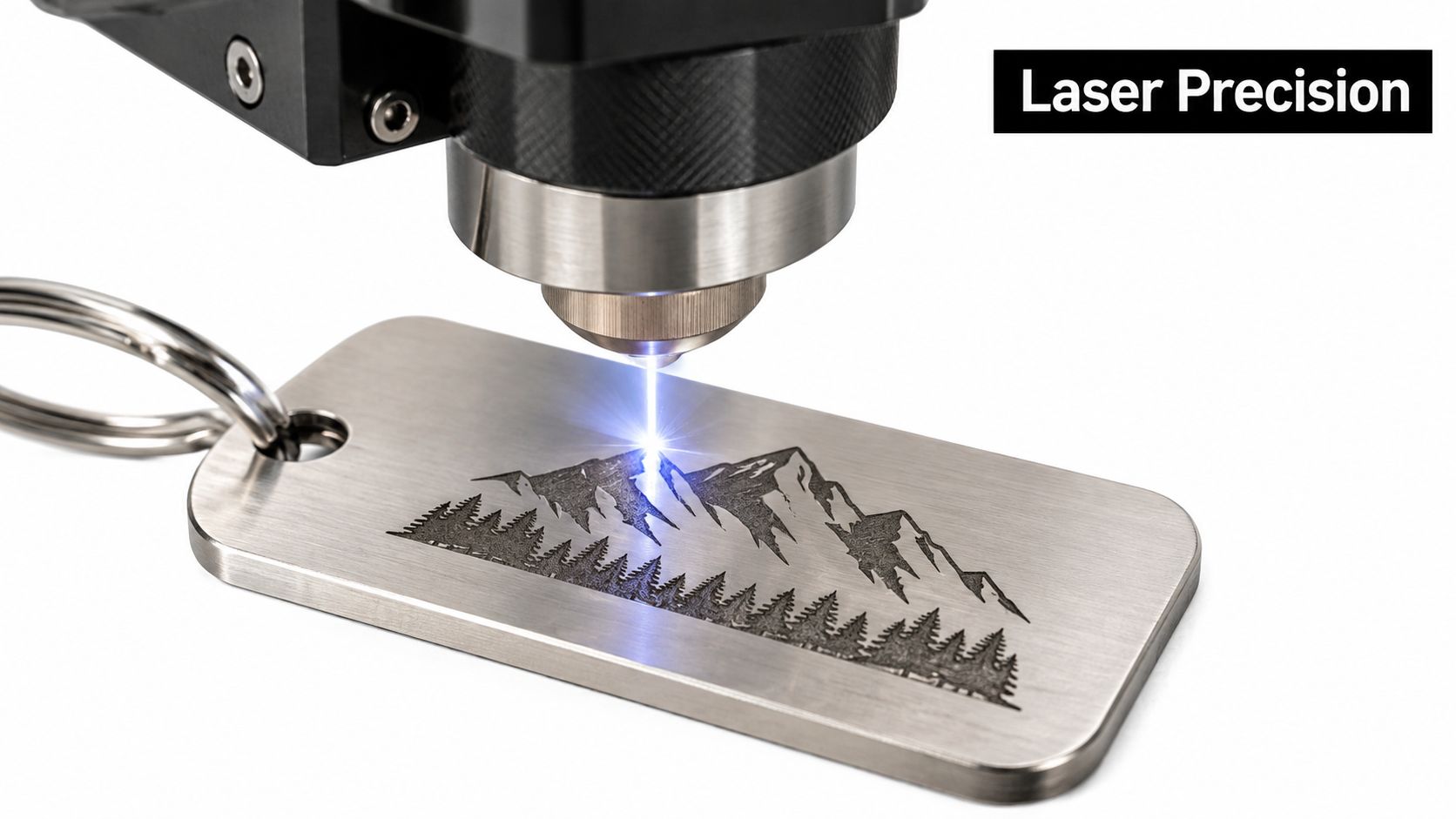
Laser engraving earns its place on harsh-duty barcode asset tags because it changes the marking instead of just placing ink on top of the surface. On anodised aluminium, the laser removes or alters the anodised layer to create a high-contrast mark. On suitable polymers, it can produce a controlled, permanent contrast without relying on a separate printed film. On stainless steel, the process can mark the surface with the finish selected for the application.
That distinction matters in the field. Printed labels can peel, fade or delaminate when the protective layer is breached. A laser-engraved identifier doesn't have an ink layer sitting on top in the same way, so there is less to catch, lift or rub away. The tag still needs to be correctly selected and attached, but the mark itself is better suited to assets exposed to cleaning, weather and repeated handling.
A supplier of Australian asset labels reports that its silver asset stickers showed no visible degradation after 7 years of artificial weather testing, a durability benchmark described in its industrial asset-label information. That result relates to a specific label construction and test method, not a universal promise for every product. It does reinforce the procurement point: ask how the proposed marking and face material have been tested, rather than accepting the word “durable” without context.
Why Trotec laser machines matter
Trotec Laser machines provide the precision needed for small identifiers, fine barcode elements, serialisation and variable data. A controlled laser process can work from a supplied asset list, maintain repeatable positioning and create consistent marks across a production run without manufacturing a separate die or stencil for every design. It also supports custom layouts where a tag needs a human-readable asset number, logo, barcode, QR code or safety information in a limited space.
The useful question isn't whether a laser can make an attractive mark. It's whether the supplier can produce a scan-tested mark with the required contrast, dimensions and quiet zones on the chosen material. A laser-engraved barcode that is too small, too shallow or poorly placed is still an operational defect.
The following Trotec Laser machine imagery shows the type of controlled, detailed marking process used for metal identification work.
Laser engraving also helps when the asset list changes late in a project. Variable serial numbers, merged databases and different code values can be produced without ordering a new set of fixed plates. That flexibility reduces the temptation to apply handwritten amendments, duplicate numbers or temporary paper labels while the permanent identification is being arranged.
The strongest case for precision engraving is lifecycle control. If the mark survives the cleaning regime and remains scannable, the operation avoids the disruption of re-tagging, record reconciliation and field investigation. The saving isn't just the price of another label. It's the avoided maintenance interruption and the preservation of trustworthy asset history.
Procurement Checklist and Partner Selection
Before approving a barcode asset tag order, ask the supplier to document the following:
- Environment: Confirm exposure to UV, chemicals, washdown, abrasion, heat, vibration and impact.
- Material: Match polyester, vinyl, anodised aluminium or 316 stainless steel to the actual duty cycle.
- Code: Choose Code 39, Code 128, QR or Data Matrix based on scanner access, data density and available space.
- Marking: Confirm whether the barcode is printed, laminated, engraved or otherwise permanently marked.
- Integration: Supply the asset list in the required format and verify every identifier against the register before installation.
- Testing: Request samples for real surfaces, scanners and cleaning procedures.
- Compliance: Check colour coding, human-readable numbers, attachment method and relevant WHS requirements.
- Production: Confirm variable-data handling, proof approval, turnaround and replacement procedures.
The industrial division connected with evright.com provides laser engraving and asset-labelling services using Trotec laser machinery, with options for durable equipment identification, barcodes, QR codes and custom metal tags. Its process combines material selection, data preparation, engraving and quality checks so the finished identifier supports the project's budget, installation schedule and operating conditions.
Evright Industrial offers custom laser-engraved asset labels and metal tags for manufacturing, utilities, healthcare, electrical equipment and compliance-driven environments. Visit Evright Industrial with your asset list, surface details and operating conditions to discuss a barcode identification solution built for the field rather than the storeroom.
Recent Comments