

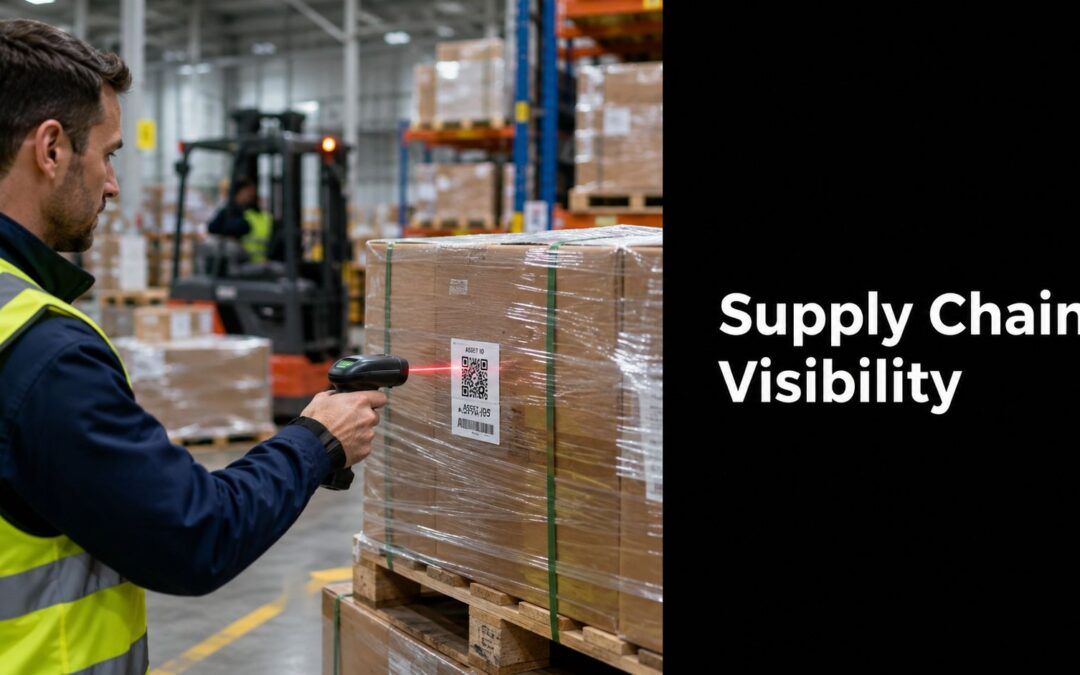
A pallet leaves a Sydney site with the right paperwork, then disappears from the planner's view somewhere before Perth. In a hospital, a device needs to be recalled, but the team can't connect its physical label to the sponsor or service record. On the factory floor, maintenance knows an asset exists, yet nobody can confirm whether it's still in service, awaiting inspection, or sitting in another site's stores.
These aren't dashboard problems alone. They're failures at the point where physical assets, operational events and business systems meet. Effective supply chain visibility solutions connect those points so people can act before a missing item becomes a production delay, a compliance issue or an unhappy customer.
What Supply Chain Visibility Solutions Actually Do
Start with four questions:
- What is it?
- Where is it?
- What happened to it?
- What should we do next?
A supply chain visibility solution combines data capture, event standards, system integration, analytics and decision workflows to answer them consistently. It may use a barcode, RFID tag, GPS signal, sensor, ERP record or asset register, but the technology is only useful when it creates a reliable operational response.
That distinction matters. Tracking usually tells you where an item is. Traceability shows its history, ownership or provenance. Visibility connects location and history with context and action. A planner doesn't just need to know that a pallet is at a depot. They need to know whether it arrived on schedule, whether its contents match the order, whether the next transport leg is booked and whether someone needs to intervene.
The Australian policy context reflects this broader meaning. The Productivity Commission released its Vulnerable Supply Chains study report on 13 August 2021, with a framework designed to identify vulnerability across Australian imports and exports. Australian Industry Standards later noted that visibility supports disruption response and more efficient inventory monitoring, while Commonwealth critical technology supply-chain principles identify transparency as important from business and national-security perspectives. Australian supply chain coverage documents this shift from a niche operational concern to a recognised foundation for resilience, compliance and risk management.

Visibility without the dashboard language
Consider a medical device with a durable identifier. At receipt, the warehouse scans it into stock. At deployment, a technician records its location and status. During servicing, the team attaches a test result to the same identity. If the device later needs to be isolated, staff can find affected units and their related records instead of searching across disconnected spreadsheets.
The same logic applies to a freight pallet or a switchboard component. The physical identity must remain readable, the event must be captured in a consistent format, and the responsible team must know what action follows.
For an example of how connected identification supports industrial asset records, see IoT device identification for industrial environments. The practical definition is simple: visibility means giving the right person a trustworthy answer about an item and a clear next action.
The Four Layers of a Modern Visibility Stack
A useful way to diagnose a visibility project is to separate the stack into four layers. Each layer has a different job, and a weakness in one layer can undermine everything above it.
Layer one, physical capture
The item becomes digitally recognisable. The tools include barcodes, RFID, UDI carriers, sensors and durable asset labels. A freight-forwarding team might scan a pallet at despatch using a Trotec laser-marked asset code. A warehouse operator might use RFID to identify several tagged items without handling each one individually.
The capture layer must work in the actual environment, not just in a demonstration area. Dust, abrasion, cleaning chemicals, sunlight, moisture and repeated handling can all affect a label or scan. If the code can't be read, every later event becomes uncertain.
Layer two, event exchange
The event layer describes what happened to the identified object. GS1 EPCIS v2.0 is designed to share granular event data between partners, including what happened, where it happened, when it happened and why. GS1 Australia's EPCIS guidance explains the role of this event standard in sharing movement and status information across supply-chain participants.
For the pallet example, an event can be written at despatch, transfer, depot receipt and delivery. The standard gives different systems a common way to interpret those events, rather than forcing every partner to translate a proprietary message.

Layer three, business systems
The event then needs somewhere useful to go. ERP, WMS, TMS and asset-register systems receive, reconcile and enrich the information. A TMS might compare an expected arrival with the actual event stream and flag a missed connection. An ERP can use the status to inform purchasing or production planning. An asset register can connect the identity to ownership, service history and location.
Integration matters. An excellent analytics platform fed by unreliable scans produces confident nonsense. The system may display a clean status, but the status is only as trustworthy as the identifier and event behind it.
Layer four, decisions
The final layer turns information into work. It includes exception queues, alerts, dashboards, planner actions and, where appropriate, AI-supported forecasting. If dwell time exceeds the operating threshold, the planner might contact the carrier, reroute the shipment or adjust a production sequence.
Practical rule: Measure the stack by the decisions it improves, not by the number of screens it contains.
If the pain is unreadable labels, invest in physical capture. If partners send incompatible status messages, address event standards and integration. If teams receive accurate information but don't act on it, redesign the decision workflow. The right investment depends on the weak layer, not on the newest platform demonstration.
Enabling Technologies Worth Knowing in 2026
The strongest deployments don't treat technology as a checklist. They select the smallest combination that solves a defined operational problem.
GS1 EPCIS v2.0 is the interoperability backbone for event exchange. It can describe what happened to a product, where and when the event occurred, and why it matters. In a freight network, a warehouse receipt, carrier handover and delivery confirmation can move between systems in a common event language. That matters more than choosing a single vendor because partners can participate without adopting identical software.
IoT sensors and GPS telematics add movement and condition data. GPS can show where a vehicle or container is travelling, while a sensor may report temperature, shock or other environmental conditions. These tools underperform when the question concerns the contents rather than the vehicle. A location signal won't prove that the correct pallet was loaded, and it won't identify which individual item inside a container needs attention.
RFID and machine vision help teams capture high volumes with less manual scanning. RFID can support receiving, stock movement and asset location workflows, while machine vision can read or inspect items as they pass a defined point. Both depend on sensible placement, tested reading conditions and a clear process for handling failed reads. For a practical introduction to RFID-supported identification, RFID asset tracking for industrial operations provides useful context.
UDI is especially relevant for medical devices because it creates a formal identification structure across the device and its packaging. It supports the connection between a physical item, its records and the organisations responsible for it.
AI-driven exception management sits at the decision layer. It can help prioritise event streams by risk, identify patterns and direct attention to likely problems. It won't repair poor master data or compensate for missing capture points. Teams still need to define what counts as an exception and who owns the response.
EDI remains part of many transport environments, particularly where partners exchange structured messages at agreed milestones. Readers who need the terminology and workflow background can use this EDI Express Tracking guide as a complementary resource. The choice is practical: combine the technologies that improve a specific decision, then make sure their data can travel between the systems already in use.
Business Benefits and the KPIs That Prove Value
Visibility earns its place when it changes a decision on the factory floor, at a freight handover or in an equipment register. A plant manager may need to prevent a line stoppage, a logistics team may need to reduce dwell, and a healthcare manager may need to prove that equipment is safe and traceable. One event history can support all three outcomes, but each team needs a KPI tied to the decision it controls.
Australian evidence shows the size of the information gap. An Australian industry report found that only 9% of organisations reported high supply chain visibility, while 47% of Australian industrials reported active supply chain disruptions in 2025 The Austroads freight report. A separate Australian study found 66% of surveyed supply chain employees were working with incomplete or inaccessible data, with 41% saying poor accessibility compromised operational efficiency and 39% reporting obstacles to meeting customer service expectations. These findings point to a practical problem: a dashboard cannot improve control if events are missing, delayed or attached to the wrong physical item.
The commercial case also needs careful translation. PwC's Australia-focused analysis estimated that leading-practice supply chain digitisation could lift GDP by 1.4% per year, worth $32.6 billion by 2030, while advanced organisations could achieve around 6.8% supply chain cost savings and 7.7% annual revenue increases. These are estimates, not guarantees for one project. An operations team should convert them into local targets, test the baseline and separate measurable benefits from assumptions.
Visibility KPIs and what they tell you
| KPI | What it measures | Maturity signal |
|---|---|---|
| Dwell time | How long freight, inventory or equipment waits at a node | The team identifies the delay cause and assigns an owner |
| On-time-in-full performance | Whether customer orders arrive as promised and complete | Planners act on exceptions before service failure |
| Recall response time | How quickly affected products or devices can be identified and isolated | Records connect item identity, location and transaction history |
| Compliance breaches | Failures against labelling, inspection or process requirements | The system creates evidence instead of relying on memory |
| Inventory accuracy | Agreement between physical stock and system records | Captures occur where stock changes state |
| Exception closure | Whether alerts result in documented action | The organisation measures resolution, not notification volume |
| Inventory turns | How efficiently stock supports operations | Better timing reduces unnecessary buffers without creating shortages |
A high event count can hide weak execution. A system may capture every scan while a late handover remains unresolved because nobody owns the response. The meaningful test is which decisions can the team make today that it could not make reliably before? That answer should connect the data layer, including EPCIS, IoT and ERP records, to the physical identity carried by a durable asset label. Without that connection, visibility remains a screen rather than a change in work.
Where Durable Asset Labelling Fits the Stack
Digital visibility starts with a physical identity. If an asset label fades, peels, smears or becomes unreadable, the ERP record may still exist, but the operator can't reliably connect that record to the object in front of them.
Australian healthcare requirements make the point concrete. Under Essential Principle 13 of Schedule 1 of the Therapeutic Goods (Medical Devices) Regulations 2002, medical devices must comply with labelling and supplied information requirements. The sponsor's name and address must appear on the device label, creating an identification anchor for downstream tracking and compliance. The Therapeutic Goods Administration labelling guidance sets out this requirement.
The TGA's UDI framework adds a machine-readable layer. Manufacturers must apply a Unique Device Identifier to the device label, to the device itself where direct marking applies, and to applicable higher-level packaging and Patient Implant Cards where relevant. Reusable devices intended for different patients must carry the UDI carrier directly on the device. That supports traceability through reprocessing and redeployment rather than relying on manual records alone. The TGA UDI labelling and packaging requirements explain how the framework applies.
The label as a compliance control
A NSW health service policy states that medical equipment must not be used unless it has a current safety test label attached. The policy connects inspection, testing and labelling with AS/NZS 3551, showing that a physical label can act as a field-level control before equipment is used. The NSW biomedical equipment testing, tagging and labelling policy provides the specific example.
This principle applies beyond hospitals. A switchboard, mobile plant item, freight pallet or infrastructure component needs an identifier that survives its working environment and remains readable to the people responsible for it. RFID can extend automated capture, but teams still need a dependable physical reference when they inspect, service, move or isolate an asset.

For teams comparing capture methods, this Waymap retail RFID guide offers useful background on how RFID supports identification and inventory workflows. The important design question is not whether a label looks attractive. It's whether it stays legible, remains attached and carries the identity needed by the next system and operator.
That's why durable asset tracking labels belong in the visibility architecture. A Trotec laser-marked code on a switchboard, bed frame or freight pallet can become the durable anchor linking EPCIS events, UDI records and asset-register history over the asset's service life.
Implementation Best Practices and Common Pitfalls
A visibility platform cannot repair weak operational data. It displays what the organisation captures and integrates. If an event arrives late, points to the wrong asset or lacks a reliable identifier, the dashboard presents uncertainty with greater polish, not greater accuracy.
Start with the decision the system must support. Operations staff should define the trigger, the expected response and the person responsible for acting. Treating implementation as an IT project leaves those details unresolved. Investing in analytics before improving capture creates the same problem. A predictive model cannot fix an unreadable label, a missed scan or duplicate asset identities.
The physical layer deserves equal attention. A durable label, validated scanner and agreed identity rule must work around real equipment, handling, heat, cleaning and freight conditions. A code that reads in a vendor demonstration but fails on a factory floor breaks the chain between EPCIS events, IoT data, ERP records and the asset in front of an operator.
Supplier visibility also has limits. Tier-2 and tier-3 relationships can hide dependencies that do not appear in a tier-1 report. Map the components, sites and partners that affect the selected workflow first. Trying to digitise every relationship at once often delays useful results.
A rollout that survives contact with the floor
Use a staged sequence:
- Choose one site or product line. Select a workflow where missing information creates a visible operational cost.
- Define one decision. It might be whether to expedite a component, quarantine an asset or reroute a shipment.
- Harden capture. Apply durable labels, validate scanners and agree on identity rules. Test them around the actual equipment, handling and cleaning conditions.
- Extend event coverage. Bring in carriers, warehouses and priority suppliers using a common event structure.
- Add analytics last. Build alerts and prioritisation after the underlying events prove reliable.
Independent analysis commissioned for GS1 estimated that supply chain standards and better visibility could contribute $19–$27 billion per year in GDP uplift and lower consumer prices by 0.4%–0.6%, according to The GS1 economic impact report. That broader value case still needs a project baseline showing where time, errors or avoidable handling costs occur.
CBRE reporting found that only 20% of organisations have full end-to-end customer visibility, while 62% of Australian occupiers rank inventory visibility and planning among their top resilience priorities. The gap between recognising the problem and operating a dependable system remains wide. Closing it requires disciplined capture, partner participation, clear ownership and data hygiene, including labels that remain readable as assets move through plants, freight networks and healthcare environments.

Putting It All Together in 2026
A workable visibility stack has four connected parts: physical capture, event exchange, business systems and decision workflows. The first part deserves attention before the others because every later record depends on the identity being readable and correctly associated with the asset.
Healthcare and essential-service environments make durable identification especially important. TGA labelling and UDI requirements create formal identification obligations for medical devices, while NSW biomedical equipment policy shows how a current physical safety label can control whether equipment is used.
Start with three actions:
- Audit the capture layer first. Check labels, scanners, RFID points and asset records in the operating environment.
- Choose one decision to improve this quarter. Define the event, owner and response before selecting more software.
- Engage a labelling partner that can supply Trotec laser-marked codes designed for the conditions your assets face.
Evright Industrial works with evright.com to support Australian manufacturing, electrical services, healthcare and infrastructure organisations with durable, regulation-ready asset labels. Connect through evrightindustrial.com.au to scope a project around the physical and digital layers together.
Evright Industrial provides durable laser-engraved asset labels, equipment identification and safety signage for demanding Australian industrial, electrical, healthcare and infrastructure environments. Visit Evright Industrial to discuss your asset identities, material requirements and Trotec laser-marked labelling project.
Recent Comments