

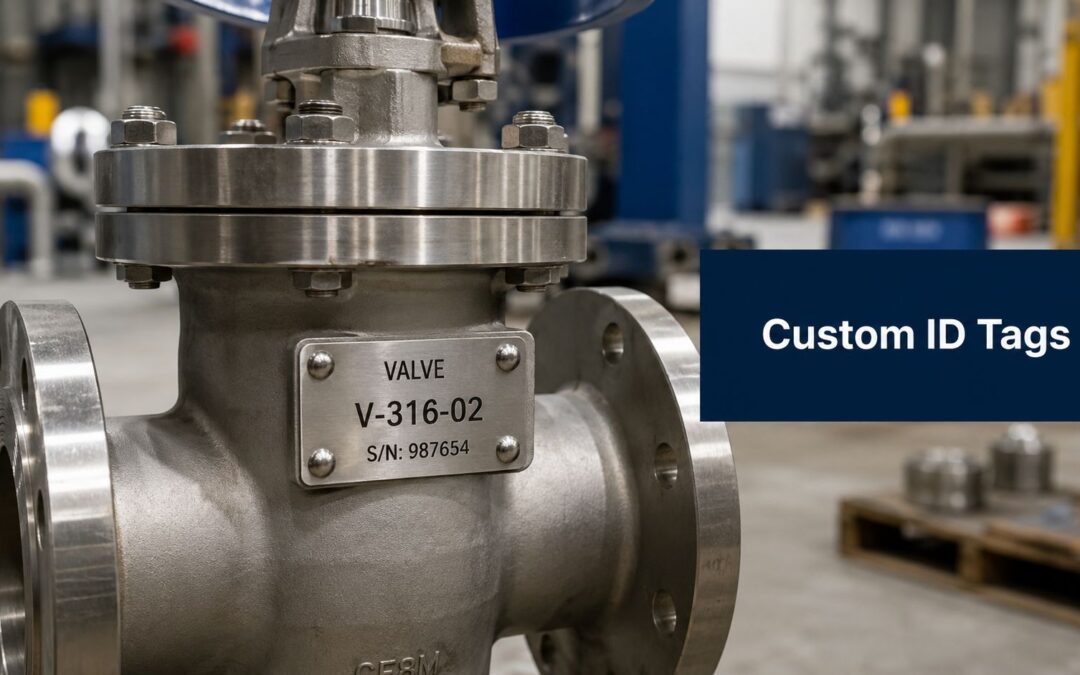
You're usually dealing with equipment tags when something has already started going wrong. A maintenance team can't confirm which pump is due for service. An electrician is tracing the wrong panel. A contractor is standing in front of a machine with a faded label, trying to match a serial number that's no longer readable. In Australian industrial environments, that isn't a small admin issue. It affects safety, compliance, downtime, and accountability.
Generic advice on asset labels doesn't help much when your site has heat, washdown, chemical exposure, coastal air, dust, UV, or constant vibration. The material, engraving method, data layout, and fixing method all matter. If one part of the specification is wrong, the tag may still look fine on day one and fail long before the asset does.
That's why custom equipment ID tags need to be treated as part of the equipment system, not as an afterthought.
Why Proper Equipment Identification Is Non-Negotiable
On a busy production floor or mine site, people make decisions fast. They isolate equipment, inspect it, restart it, lock it out, log maintenance, and respond to faults under pressure. If the tag is missing, ambiguous, or illegible, the risk multiplies quickly.
That's one reason custom equipment ID tags have been mandated under Australian WHS regulations since 2011, with the AS/NZS 4500 series requiring industrial assets to be permanently marked with unique identifiers for traceability and safety compliance. Adoption is already widespread. According to the Australian Bureau of Statistics (2023), 78% of manufacturing facilities in Australia use standardised metal or anodised aluminium ID tags for asset tracking, reducing equipment misidentification incidents by approximately 45% over five years.
Compliance starts with clear identification
The legal side matters, but the practical side matters just as much. If your plant register, service records, permits, and lockout procedures all point to an equipment number, that number must exist physically on the asset and remain readable in real operating conditions.
A proper tag gives teams a fixed reference point. It links the physical machine to the maintenance record, the spare parts list, the inspection history, and the operating procedure. If you're also reviewing broader record control, mastering hydraulic documentation is a useful companion read because equipment traceability breaks down fast when labels and documentation drift out of sync.
Practical rule: If a technician has to guess whether they're looking at pump P-104 or P-140, the tag system has already failed.
Bad tags cost time before they cost money
Most sites notice the problem first as friction. People slow down. They double-check spreadsheets. They call supervisors. They photograph equipment and ask someone else to confirm what they're standing in front of.
Then the bigger issues show up:
- Maintenance confusion: Work orders get matched to the wrong asset or delayed while teams verify identity.
- Audit exposure: Compliance checks become harder when labels are inconsistent, missing, or not permanent.
- Safety risk: Isolation, service, and restart tasks rely on precise identification.
- Asset history gaps: When one machine carries multiple legacy labels, nobody trusts the record trail.
That's why tag strategy should sit alongside your broader asset tracking best practices, not outside it.
Standard tags aren't enough for demanding sites
A hand-written sticker, printed laminated label, or low-grade plastic plate might survive in an office storeroom. It won't hold up on a compressor skid, a coastal treatment plant, or a washdown-prone food line.
In industrial settings, the right tag does three jobs at once. It stays attached. It stays legible. It matches the way your teams identify equipment in the field.
Choosing Materials for Durability in Australian Conditions
The wrong material usually fails in a predictable way. It goes brittle, fades, corrodes, curls, cracks, or loses contrast until the engraved or printed data can't be trusted. Australian conditions speed that up. UV, salt, abrasive dust, chemical splash, and high surface temperatures punish anything that was specified for a mild indoor environment.

Stainless steel for severe exposure
When the environment is hostile, stainless steel is the benchmark. For custom equipment ID tags in Australian chemical processing and mining environments, stainless steel in 304 or 316 grade is the industry-standard material because it withstands temperatures exceeding 500°C and resists abrasion, fuming chemicals, and UV degradation. Polymer-based tags typically fail above 120°C and degrade rapidly under direct sunlight, making them unsuitable for outdoor Australian applications, as outlined in this technical guide to durable asset tags for hostile industrial environments.
316 grade is the stronger choice where chlorides or saline air are involved. That includes coastal infrastructure, marine-adjacent plant, and washdown areas where aggressive cleaning is routine. 304 still performs well across many indoor and sheltered industrial settings, but if corrosion is a serious concern, 316 gives you more margin.
Use stainless when the tag has to survive the same punishment as the asset casing.
Anodised aluminium for broad industrial use
Anodised aluminium is often the best balance of durability, readability, weight, and cost for general manufacturing and asset identification. It's well suited to machine tags, equipment registers, QR-based asset programs, and internal plant identification where the exposure is serious but not extreme enough to demand stainless.
It also works well with laser engraving. The contrast is crisp, serialisation is efficient, and the finished tag stays neat across large production runs. For operations planning a consistent fleet-wide specification, custom metal asset tags are a practical reference point for available formats and material choices.
Brass and where it fits
Brass still has a place, but it's specialised. It suits heritage equipment, commemorative machinery plates, architectural plant rooms, and premium applications where appearance matters alongside function. It's not the first choice for rough industrial service, but it can be the right one for protected environments and presentation-driven jobs.
What doesn't work well outdoors
A lot of poor tag performance comes back to false economy. Teams choose a plastic or polymer option because it's available quickly or looks acceptable in the sample tray. Then it goes onto an outdoor cabinet, an exposed valve set, or a piece of mobile equipment.
That's where material mismatch bites.
| Material | Where it works | Where it struggles |
|---|---|---|
| 316 stainless steel | Coastal, chemical, mining, high-heat, abrasive areas | Higher material cost, heavier |
| 304 stainless steel | General harsh industrial use | Less resistant than 316 in saline exposure |
| Anodised aluminium | General asset tracking, machinery, indoor and moderate outdoor use | Not the first pick for the harshest corrosive sites |
| Brass | Heritage, architectural, premium presentation | Less suited to severe industrial wear |
| Polymer or plastic tags | Sheltered, low-heat, low-UV settings | Outdoor Australian UV and high-heat exposure |
A tag material should be chosen by site condition first, then budget. Doing it the other way around usually creates a re-tagging project.
Think in asset life, not purchase price
In the Australian industrial sector, tags are commonly produced in 1.5 mm to 3 mm anodised aluminium or stainless steel, with lifecycle durability exceeding 15 years in harsh environments. A 2024 industry report estimated more than 2.3 million equipment ID tags were installed across manufacturing, electrical, and healthcare facilities in Australia in the past year, with 67% incorporating barcode or QR code technology. The same report notes an average cost per tag of AUD $4.50 to $12.00, with bulk orders reducing costs by up to 20%. MarkServ Australia (2023) reported that 89% of surveyed industrial clients saw improved maintenance scheduling and compliance tracking after implementing custom ID tag systems, and tags with embedded QR codes enabled a 30% faster response time during equipment audits and emergency situations across the AU region.
Those numbers matter because they shift the conversation. The accurate comparison isn't cheap tag versus premium tag. It's one purchase versus repeated replacement, asset confusion, and field labour spent correcting preventable failures.
Designing Tags for Readability and Data Integration
A durable blank plate still isn't a good equipment tag until the information layout is right. Without proper layout, many tag projects go off track. People try to fit too much data into too little space, then wonder why nobody can read the result from arm's length in a dim plant room.

Put the human-readable data first
The first job of an equipment tag is immediate identification by a person on site. That means the equipment number must be obvious. If there's room, the common asset name should sit with it, not in a separate system that only office staff can see.
Good layouts usually follow a clear hierarchy:
- Primary line: Equipment number or asset ID.
- Secondary line: Common name or functional description.
- Machine data: Serial number, model, voltage, service details, or other relevant fields.
- Digital layer: Barcode or QR code for scanning into the asset register.
This is why condensed text blocks rarely perform well. They may satisfy a data list, but they don't support fast field use.
QR codes need space and contrast
Digital integration is no longer optional on many sites. In the Australian industrial sector, the average cost per custom equipment ID tag ranges between AUD $4.50 and $12.00, depending on material, size, and customisation. A 2024 industry report estimates that 67% of these tags now incorporate barcode or QR code technology for digital asset management, with QR codes enabling a 30% faster response time during equipment audits.
That doesn't mean every tag should be packed with a tiny QR code. A code that scans poorly wastes everyone's time. It's better to enlarge the plate or simplify the content than to shrink the digital element below what's practical in dust, glare, or low light.
A few design choices help immediately:
- Use plain fonts: Sans serif fonts with clear character separation reduce read errors.
- Keep contrast high: Dark marking on a light metal face, or the reverse, works best when grime builds up.
- Leave quiet space around codes: Crowded QR placement hurts scan reliability.
- Avoid decorative layouts: Machine tags are working tools, not brochure graphics.
For teams standardising engraved plates across equipment classes, engraved metal labels are useful when you need a repeatable format with serialisation and clean data fields.
If the code scans but the technician still can't identify the asset at a glance, the design is incomplete.
Decide what belongs on the tag and what belongs in the system
Not every data field needs to live physically on the plate. The tag should carry the information needed for safe recognition and quick action. Supporting records can sit behind the QR code or barcode inside your maintenance platform.
That usually means putting permanent identifiers on the tag and keeping dynamic service history in the digital system. The cleaner that split is, the longer your tag design stays relevant.
Fixation Methods and Installation Best Practices
Even a well-made tag fails if the mounting method doesn't suit the asset. Attachment should be chosen the same way the material is chosen, by looking at surface type, vibration, cleaning method, temperature, and access for installation.
Put the tag beside the point of use
Placement is part of fixation. Best practice for custom equipment ID tags mandates labelling adjacent to critical components such as valves or electrical panels rather than on the moving part itself, to prevent interference with operation. Tags should include both the equipment number and common name to avoid operational delays during maintenance, as shown in this industry guidance video on equipment labelling practice.
That principle solves two common mistakes. First, tags mounted on moving guards, shafts, or hinged covers tend to wear or detach. Second, tags placed too far from the relevant component force technicians to hunt around during service or isolation.
Match the fixing method to the surface
Different assets need different approaches.
- Industrial adhesive: Best on smooth, clean, flat surfaces where drilling isn't desirable. Surface prep matters. Oil, powder coat contamination, and textured finishes reduce bond strength.
- Rivets or screws: The safer option for high-vibration equipment, outdoor enclosures, mobile plant, and long-life installations. If failure isn't acceptable, mechanical fixing is usually the better call.
- Wire or chain attachment: Useful for valves, cable groups, and components that don't offer a practical flat mounting face. Choose corrosion-resistant hardware so the fixing doesn't fail before the tag.
Installation errors that cause avoidable failures
Most premature losses come from a short list of site habits:
| Installation issue | Likely result |
|---|---|
| Fixing to a moving part | Tag damage or operational interference |
| Poor surface preparation | Adhesive failure |
| Undersized hardware | Tag loosening in vibration |
| Bad placement near impact points | Bent, scraped, or unreadable tags |
A good installation should leave the tag visible, secure, and serviceable without becoming a snag point or maintenance obstacle.
Custom ID Tags Across Australian Industries
The specification changes by sector because the working conditions change. The best custom equipment ID tags aren't generic. They reflect how each industry identifies, services, audits, and protects its assets.

Manufacturing
A manufacturing site usually wants consistency above all else. One line may have pumps, guards, control panels, conveyors, hydraulic units, and test stations from different eras and vendors. If every asset carries a different label style, the plant register becomes harder to use.
The strongest approach is a standard family of machine tags with fixed field positions. Asset ID first. Common name second. Then the machine-specific details. Anodised aluminium is often the practical fit here because it handles general industrial wear well and supports clean laser-engraved serialisation.
Electrical and utilities
Electrical contractors and essential service providers need labels that stay readable in the field and make sense during isolation, inspection, and fault-finding. Control cabinets, switchboards, cable routes, pump stations, and service panels all benefit from clear, adjacent identification.
This is one area where poor wording causes delays. A panel number alone may mean something to a drawing set, but adding the common name reduces hesitation on site. The tag has to work for the technician with gloves on, not just for the spreadsheet.
On electrical work, clear identification reduces the amount of time people spend confirming they're at the right point before they touch anything.
Healthcare
Healthcare equipment tagging needs a different mindset. The environment is cleaner, but the demands are still strict. Teams need asset identification that supports inventory control, servicing, and traceability without creating labels that peel at the edges or become unreadable after repeated cleaning.
Compact engraved tags with barcodes or QR codes are often the practical solution because they stay crisp and don't rely on surface printing that can wear away. Layout matters more than decoration. Biomedical teams need scan-ready data and immediate visual identification.
Government and defence
Government infrastructure and defence-related environments tend to prioritise permanence, legibility, and standardisation. Assets may be spread across multiple sites, managed by different contractors, or subject to long record-retention expectations.
That usually pushes the specification toward durable metals, tightly controlled naming conventions, and serial formats that don't change with personnel or software platforms. Simplicity wins here. A clear permanent tag outlasts many administrative systems.
Mining and resources
Mining is where material choices get exposed quickly. Dust, impact, abrasion, UV, and constant handling punish weak labels. Stainless steel becomes the safer answer on many assets because the tag has to survive rough service and remain legible long after installation.
A site may also need larger text, deeper contrast, and more durable fixing hardware than a factory would. The reading distance is often greater. The equipment is dirtier. The consequences of misidentification are sharper.
Memorial and specialist applications
Not every engraved industrial-grade plate is going onto plant equipment. Some clients need durable identification or commemorative plaques for specialist installations, memorial settings, or public assets where longevity and presentation both matter. Brass and selected aluminium formats often fit these projects well, depending on exposure and aesthetic goals.
The common thread across all sectors is straightforward. The right tag reflects the environment, the user, and the operational task.
The Evright Industrial Advantage with Trotec Laser Technology
The engraving process matters just as much as the material. A good metal blank can still become a poor tag if the marking method lacks precision, consistency, or long-term permanence.
Laser capability makes a real difference.

Why Trotec Laser is the right fit for industrial tags
Anodized aluminum tags laser engraved with Trotec laser machines provide permanent, consumable-free marking without contact or wear, enabling high-precision creation of serialized machine tags and data plates directly from BMP files using SpeedMark software, according to Trotec Laser's data plates and tags documentation.
That matters for industrial identification because repeatability is everything. If you're producing one tag, almost any decent process can look acceptable. If you're producing a large run with sequential numbering, barcodes, QR codes, fixed hole positions, and multiple material formats, process control becomes the difference between a neat system and a messy one.
Laser engraving also avoids the wear issues that come with contact-based marking methods. Fine detail stays sharp. Serial data stays consistent. The result is a tag that looks organised and performs like a permanent identifier rather than a temporary label.
Precision becomes visible in the finished tag
With industrial asset labels, people often notice quality in the details they can't quite name. Text alignment is consistent. Codes scan cleanly. Hole spacing is accurate. Borders and field lines are crisp. The whole plate looks deliberate.
Those details come from process discipline and machine accuracy, not luck.
Evright Industrial is a specialised division of Australia's leading awards company, evright.com, bringing nearly six decades of engraving expertise to the industrial sector. Our process utilizes this deep knowledge, using advanced Trotec lasers to permanently mark durable materials for asset tracking and compliance needs that last a lifetime.
For a closer look at the process, this Trotec Laser video shows the kind of laser workflow that suits high-precision industrial marking.
What that means in practice
When a tag is produced properly, the benefits show up in the field:
- Sharper data fields: Easier reading of serials, model references, and compliance text.
- Reliable serialisation: Better consistency across large asset fleets.
- Cleaner digital marking: QR codes and barcodes are easier to scan when edges are precise.
- Long-term presentation: The tag still looks professional after installation, not like a compromise.
That's the standard industrial teams should expect when they specify custom equipment ID tags for serious use.
Your Ordering Process and Final Checklist
Ordering custom equipment ID tags goes smoothly when the specification is complete before production starts. Most delays don't come from engraving. They come from missing decisions on material, dimensions, fixing, or data format.
Start with the application, not the artwork
The first question isn't what the tag should look like. It's what the tag has to survive. Heat, UV, chemical splash, washdown, abrasion, vibration, and indoor or outdoor placement should drive the material choice and fixing method.
Then define the practical limits. How much space is available on the asset? Does the tag need drill holes? Does it need rounded corners? Will the operator read it from close range or from a distance?
Prepare the data properly
For one-off tags, a text list may be enough. For larger runs, consistency is everything. Serial numbering, equipment names, barcode values, and QR content should be checked before the job reaches production.
A clean spreadsheet usually avoids the most common errors. So does agreeing on a naming convention before tags are made. If the asset register uses one format and the physical tag uses another, the whole benefit of the system gets diluted.
Ordering tip: Approve one sample layout first. It's much easier to correct a field order or text hierarchy before a full run is engraved.
Use this checklist before requesting a quote
- Asset environment: Indoor, outdoor, coastal, chemical, washdown, high-heat, abrasive, or mixed conditions.
- Material choice: Stainless steel, anodised aluminium, brass, or another suitable option based on exposure.
- Tag size and shape: Overall dimensions, corner style, thickness preference, and any space restrictions on the asset.
- Fixing method: Adhesive, rivets, screws, or wire attachment. Include hole size and hole position if needed.
- Text fields: Asset ID, common name, serial number, model, warning text, or compliance information.
- Digital content: Barcode or QR code, plus the exact data each code should contain.
- Artwork and files: Vector artwork, spreadsheets for serialisation, and any logo or layout requirements.
- Quantity and batching: One-off run, staged delivery, or large volume order.
What affects price
Cost usually comes down to material, quantity, size, hole requirements, and how complex the variable data is. In the Australian industrial sector, the average cost per custom equipment ID tag ranges from AUD $4.50 to $12.00 depending on material, size, and customisation, and bulk ordering can reduce unit cost.
That's why it helps to standardise where possible. A controlled family of tag sizes and layouts is easier to manufacture, easier to reorder, and easier for your site team to recognise.
Final check before sign-off
Before approving production, confirm five things:
- The material suits the environment.
- The main identifier is readable at practical distance.
- The fixing method matches the asset.
- The digital code has enough space to scan reliably.
- The tag wording matches the asset register exactly.
Get those five right and your tags will do what they're supposed to do. They'll identify the asset clearly, survive the environment, and support the way your team works.
If you're ready to specify durable, site-ready tags, Evright Industrial can help with material selection, layout planning, serialisation, and laser-engraved production for Australian compliance and asset tracking requirements. Share your equipment list, tag sizes, environment, and fixing needs, and the team will turn that into a practical quoting and production plan.
Recent Comments