
If you're an Adelaide business looking for safety signage, you know the score: you need signs that are compliant, tough, and impossible to miss. This isn't just about ticking a box for the regulators. It's a core part of creating a workplace that's safe, productive, and on the right side of the law, especially in tough industrial settings.
Why High-Quality Safety Signage Is a Must for Adelaide Businesses
Picture a bustling manufacturing floor in Wingfield, or a worksite getting battered by the coastal winds near Port Adelaide. In places like these, clear and sturdy safety signs are more than just a good idea—they're your first line of defence against accidents that should never happen. A poorly made sign that's faded, damaged, or just plain wrong can cause serious confusion, leading to injuries and shutdowns that no business can afford.
The risk of getting this wrong goes well beyond the immediate physical danger. For any Adelaide business, failing to comply with SafeWork SA regulations and Australian Standards can land you in hot water, with serious legal and financial penalties. It really hammers home why you need to get your signage right from the very beginning.
The Real-World Cost of Subpar Signage
Cutting corners on compliant, high-quality safety signage can hit your operations hard and fast. Here’s what can happen:
- More Workplace Incidents: Vague or unreadable signs are a recipe for mistakes. It could be a worker forgetting their PPE or wandering into a chemical storage area they shouldn't—all because the warning wasn't clear. That's how injuries happen.
- Legal Headaches: If an accident does occur, you can bet a SafeWork SA investigation will look closely at your safety systems. Non-compliant signage can be seen as a direct failure in your duty of care, opening you up to massive fines and even prosecution.
- Costly Downtime: An incident often means everything grinds to a halt for investigations and safety reviews. That kind of lost productivity is incredibly expensive.
- A Hit to Your Reputation: A bad safety record makes it tough to attract good people and win new contracts. It sends a clear message that employee welfare isn't a top priority.
Building a Foundation of Safety
Think of professionally made safety signage as the bedrock of a strong safety culture. It’s a silent, constant reminder that reinforces training and highlights hazards 24/7. When you partner with a local specialist who gets the unique industrial challenges here in Adelaide, you're ensuring your signs are truly fit for purpose. To get a better handle on this, you can dig deeper into why signage is a critical part of commerce and life and the role it plays every single day.
Putting money into premium safety signage isn't an expense—it's an investment. You're investing in your people, your productivity, and the future of your company. It shows everyone who walks onto your site that you are completely committed to their safety.
Navigating Adelaide's safety signage rules can feel like you're trying to piece together a complex puzzle. But here’s the good news: for Adelaide businesses, the core rules are actually pretty straightforward. They’re all built for one purpose – keeping people safe with clear, immediate communication.
The main guide every South Australian business needs to have on their radar is Australian Standard AS 1319-1994.
Think of this standard as the official rulebook for safety signs on any worksite. It cuts through the guesswork by setting out a universal language of colours, shapes, and symbols. Getting this right is a cornerstone of solid compliance risk management and helps you tick all the necessary regulatory boxes. It’s like a visual grammar that everyone on site, from a first-day apprentice to a seasoned supervisor, can understand in a heartbeat.
Decoding the Language of Safety Signs
The Australian Standard sorts signs into a few key categories, each with its own non-negotiable visual code. Getting these right isn't just about ticking a box; it's about making sure your message hits home instantly, without a moment's confusion.
Prohibition Signs: These are the "don't do this" signs. You'll recognise them by the bold red circle with a slash over a black symbol on a white background. The classic "No Smoking" sign near flammable goods is a perfect example.
Warning Signs: These give you a heads-up about non-life-threatening hazards. They're hard to miss: a black triangle on a bright yellow background, like a "Slippery When Wet" sign.
Mandatory Signs: These signs tell people what they must do to stay safe. They feature a white symbol inside a blue circle—think "Safety Glasses Must Be Worn" in a workshop or factory.
Emergency Information Signs: When things go wrong, these signs are your guide to safety. They're always green and white, pointing the way to first aid stations, emergency exits, or safety showers.
Putting Standards into Practice in Adelaide
When you start thinking about real-world Adelaide workplaces, applying these standards makes perfect sense. Picture a busy Barossa Valley winery; that yellow warning sign for hazardous chemicals is absolutely crucial during the bottling process. In the same way, every high-rise in the CBD relies on those green emergency signs to clearly mark fire escapes, guiding people to safety if an evacuation is needed.
For the industrial heartlands of Adelaide, local specialists like Evright Industrial are key. They produce incredibly durable, laser-engraved safety signage that stands up to our harsh coastal air, ensuring the messages on beaches, manufacturing sites, and utility depots stay clear for years. Their precision engraving on quality materials meets the tough Australian standards, cutting down the risk of misinterpretation in high-stakes environments like hospitals and infrastructure projects.
The whole point of AS 1319-1994 is consistency. When a worker sees a blue circular sign, they don't have to stop and squint at the fine print; they instantly know an action is required. That split-second recognition is what prevents accidents.
Guidance from SafeWork SA
Beyond the national standard, SafeWork SA offers essential guidance specifically for South Australian businesses. Their job is to make sure workplaces are safe, and believe me, they take signage seriously during site inspections. They expect businesses not just to have the right signs, but to place them correctly, right where the hazards are.
Visibility and maintenance are a huge part of this. A sign tucked away behind a piece of machinery or so faded you can't read it is just as useless as no sign at all. SafeWork SA requires your safety signs to be clear, well-lit, and in good nick at all times. Following their guidance is the surest way to build a genuinely safe workplace, steer clear of fines, and meet your duty of care to every single person who walks onto your site. It’s this systematic approach that ensures every piece of safety signage Adelaide businesses install actually does its job.
Choosing the Right Materials for Lasting Durability
A safety sign that fades, peels, or corrodes is more than just an eyesore; it's a safety failure waiting to happen. In Adelaide, where our worksites can face everything from the intense summer sun to salty coastal air, picking the right material for your safety signage isn’t just a nice-to-have—it’s absolutely fundamental.
The material you choose is what determines how well a sign will stand up to its environment, making sure it stays clear, readable, and compliant for years to come.
Think of it this way: you wouldn't build a jetty at Glenelg with untreated pine and expect it to last. You’d choose marine-grade steel designed to handle the salt spray and constant moisture. The exact same logic applies when selecting safety signage Adelaide businesses can count on. Matching the material to your site's specific conditions is a smart investment in long-term safety.
The Impact of Adelaide's Climate on Signage
Adelaide’s climate presents a unique set of challenges. An outdoor sign on a construction site in the northern suburbs has to endure blistering UV radiation that can bleach colours and degrade plastics. Over at a Port Adelaide facility, that same sign needs to resist the corrosive effects of salt-laden air.
Move inside a factory in Wingfield, and a sign might be exposed to chemical splashes, high humidity, or extreme temperatures. Each of these scenarios demands a different material to guarantee durability. If you make the wrong choice, you'll be replacing signs far too often, wasting money and creating dangerous gaps in your compliance.
This decision tree is a great starting point for figuring out what you need based on the immediate hazard.
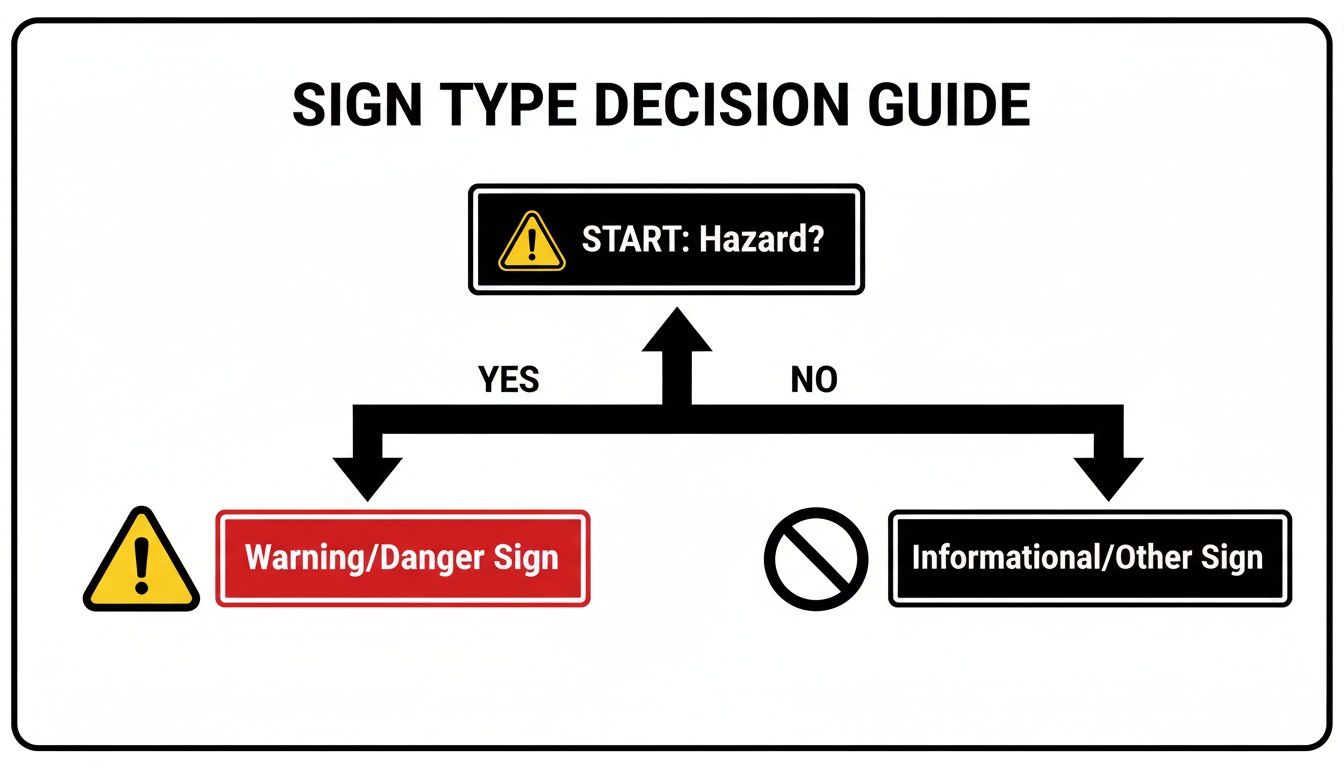
It helps simplify that first choice, guiding you toward either a warning sign for hazards or an informational sign for general guidance, which then helps narrow down your material needs.
Comparing Key Industrial Materials
When it comes to materials, it's always a balance between durability, application, and cost. For industrial environments, a few materials have proven themselves time and time again. Here’s a rundown of the most effective options we work with at Evright Industrial, where we use advanced Trotec Laser machines to create permanent, pin-sharp markings.
Choosing the right material from the get-go saves a lot of headaches down the track. Here's a quick comparison to help you decide.
Material Comparison for Adelaide's Industrial Environments
| Material | Key Properties | Best Suited For (Adelaide Examples) |
|---|---|---|
| Traffolyte | Multi-layered plastic, chemical resistant, ideal for detailed engraving, non-conductive. | Switchboard labels in a manufacturing plant, machinery ID tags in a workshop, valve tags in a utility station. |
| Stainless Steel | Extremely durable, corrosion-proof, heat and chemical resistant, hygienic. | Food processing areas in beverage plants, marine equipment signage at Port Adelaide, chemical warning signs. |
| Anodised Aluminium | Lightweight yet strong, UV and scratch-resistant, weather-proof, professional finish. | Outdoor directional signs on a large site, fire safety notices, general warning signs exposed to sunlight. |
Ultimately, picking the right material ensures your signs will do their job for the long haul, no matter what Adelaide's conditions throw at them.
Here's a closer look at the options:
- Traffolyte: Also known as laminated phenolic, Traffolyte is the go-to for detailed machinery labels and control panels. It's made of layered coloured plastic, so our Trotec Laser machines can engrave through the top layer to reveal a contrasting colour underneath. This creates incredibly clear, permanent text that can't be rubbed off or faded by chemicals.
- Stainless Steel: For the absolute toughest environments, nothing beats stainless steel. It’s exceptionally resistant to corrosion, chemicals, and extreme heat, making it perfect for food processing, marine, and chemical industries. You can learn more about our stainless steel signs to see how we use this for high-endurance applications.
- Aluminium: Lightweight yet incredibly strong, aluminium is a versatile choice for both indoors and out. Anodised aluminium, in particular, offers fantastic resistance to UV rays and scratches, making it a reliable workhorse for outdoor signs across Adelaide.
The goal is to make a one-time investment that lasts. By engraving onto a robust material like Traffolyte or stainless steel with a high-precision Trotec Laser machine, you are creating a safety asset that will not fail, peel, or fade, ensuring your message remains understood for its entire service life.
Even for the small stuff, material choice is critical. For things that need frequent updates but still have to withstand tough workplace conditions, selecting the right durable tape for P-Touch labels ensures long-term readability. A robust safety system is strong from the largest warning sign right down to the smallest equipment tag.
The Precision and Power of Laser Engraving Technology
When a critical moment hits, what makes a safety sign truly effective? The answer is simple: unmistakable clarity.
While a printed sign might do the job for a little while, modern laser engraving is in a completely different league. It offers a level of precision and permanence that turns a simple piece of metal or plastic into a safety asset built to last.
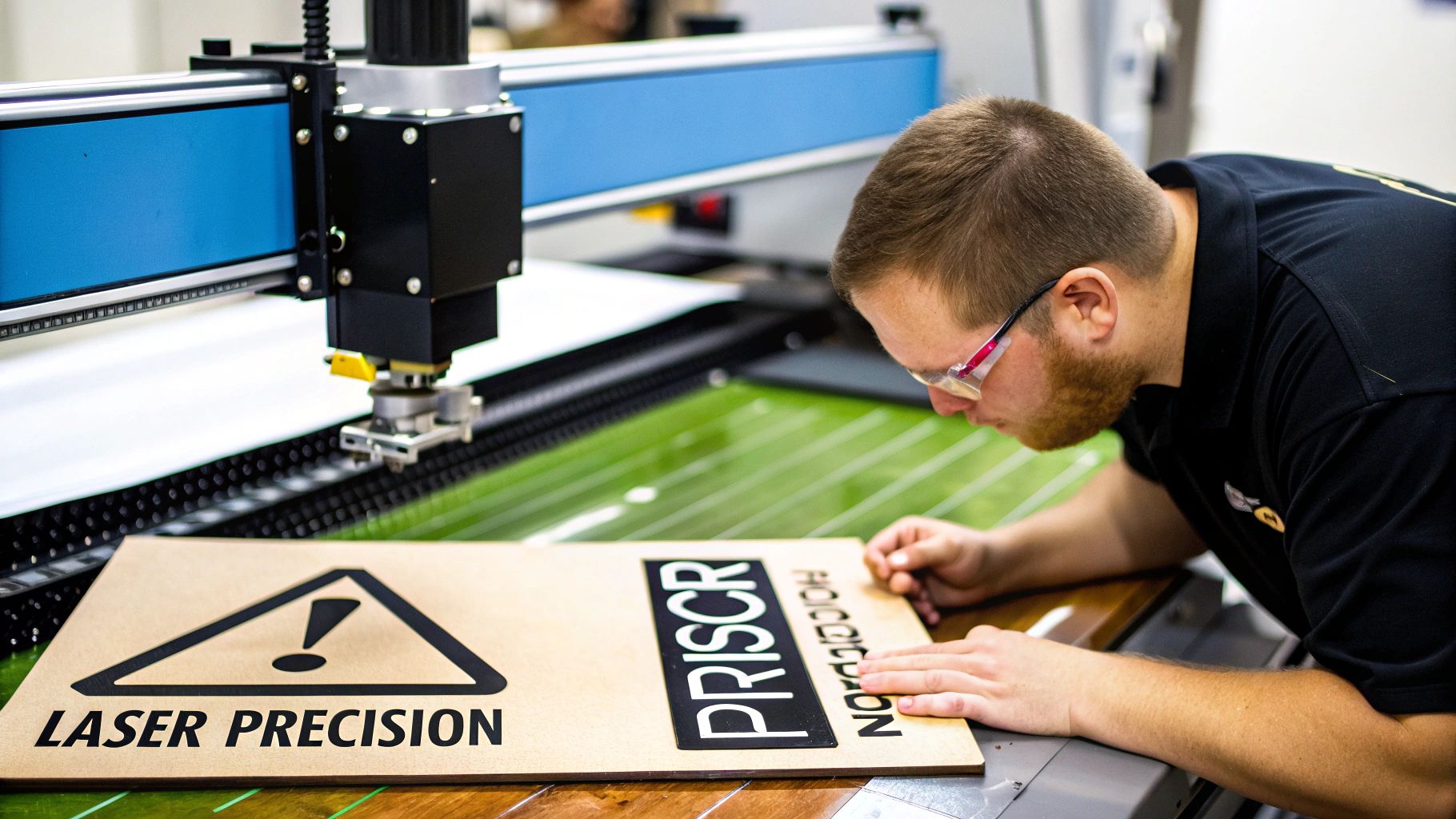
The process is pretty clever. It uses a highly focused beam of light to physically etch designs, text, and symbols straight into the material’s surface. Unlike inks or adhesives that just sit on top, engraving creates a permanent mark. It won’t peel, fade, or wear away, even in Adelaide’s most demanding industrial environments.
Why Pinpoint Precision Matters
Here at Evright Industrial, we use advanced Trotec Laser machines, which are famous for their incredible accuracy. Think of the difference between writing with a chunky marker versus a fine-tipped pen. Our Trotec Laser machines are like the finest pen imaginable, creating razor-sharp text and symbols that leave no room for misinterpretation.
This kind of detail is absolutely vital for safety signage. When an emergency strikes, there's no time for second-guessing. A clear, crisp message ensures instructions are understood instantly, which can be the difference between a near-miss and a serious incident.
Durability Forged by Light
Laser engraving doesn't just create a mark; it forges it right into the material. The process physically alters the surface, meaning the markings are as durable as the sign itself. This gives our signs some key advantages for industrial use:
- Permanent Legibility: The engraved text can't be rubbed off by cleaning, worn away by friction, or damaged by chemical spills.
- Weather Resistance: Signs made from materials like stainless steel or Traffolyte are completely unfazed by Adelaide’s harsh sun and coastal humidity.
- Vandal Proof: Because the markings are physically etched into the surface, they are incredibly difficult to scratch out or alter.
This built-in durability makes laser-engraved signs a smart, long-term investment for any business that's serious about safety and compliance.
The real benefit of laser engraving is creating a sign that you can install and trust for years. It delivers a permanent message that remains clear and compliant, safeguarding your team and your operations without the need for constant replacement.
You can't overstate the importance of durable, clear signage, especially when public safety is on the line. For example, recent studies from the University of Adelaide found alarming confusion over beach safety signs, directly linking poor comprehension to drownings. The research revealed that a huge number of people misunderstood basic instructions, highlighting the need for industrial-grade solutions to improve clarity and durability in high-risk public areas. This is exactly where our capabilities come into play.
When you partner with us, you get access to this state-of-the-art technology. Our skilled technicians use Trotec Laser machines to craft custom, compliant, and incredibly durable safety solutions for businesses across Adelaide. We take robust materials and transform them into vital assets that protect your team and your investment.
To see what we can do, feel free to explore our laser engraving services in Adelaide.
Your Essential Checklist for Buying Safety Signage in Adelaide
When you're ready to outfit your workplace with safety signage, having a clear game plan is the difference between simply ticking a box and genuinely investing in your team's wellbeing. This practical checklist walks you through the essentials, helping you make smart, informed decisions for your Adelaide business.
Following a structured process takes the guesswork out of it and guarantees you cover all your bases, from the initial site walk-through to the final installation.
1. Start with a Thorough Site Risk Assessment
Before you even think about buying a single sign, you need to know exactly what you need and why. Walk through your entire worksite with one goal in mind: spotting potential hazards.
- Pinpoint areas with moving machinery, chemical storage, or busy vehicle traffic.
- Keep an eye out for potential slip, trip, and fall hazards.
- Map out the locations of all your emergency gear – think fire extinguishers, first aid kits, and emergency exits.
This assessment is the bedrock of your signage strategy. It ensures every sign you purchase has a clear, necessary purpose.
2. Double-Check Compliance with Australian Standards
Your next move is to make sure every sign you’re considering is legally compliant. All safety signage in Adelaide must meet the requirements of Australian Standard AS 1319-1994.
This isn't just about picking a sign that looks right; it's about verifying that the colours, shapes, and symbols are correct for the message. Red for prohibition, yellow for caution, blue for mandatory actions, and green for safety information. The simplest way to get this right is to work with a reputable supplier who guarantees their products are fully compliant.
3. Choose Materials Built for the Environment
A sign is only as good as the material it’s made from. You have to think about the specific conditions where each sign will live.
An outdoor sign down at Port Adelaide has to stand up to salt spray and harsh UV rays, while an indoor machinery tag in a factory needs to shrug off chemical splashes and high heat. A one-size-fits-all approach just won’t cut it.
This is where durable materials like Traffolyte, stainless steel, or anodised aluminium become critical. Using advanced Trotec Laser technology, we engrave these materials to create permanent markings that won't fade, peel, or corrode over time. It’s an investment that ensures long-term legibility and saves you a fortune on replacements down the track.
4. Get the Size Right for Maximum Visibility
A sign that’s hard to see is a useless sign. It’s as simple as that. The size of your signage needs to be dictated by the distance from which people need to read it.
Make sure the text and symbols are big and clear enough to be understood from a safe distance. This gives your crew and any visitors enough time to see the sign, process the information, and react accordingly. This is especially vital for warning and emergency signs, where split-second recognition can make all the difference.
Safety Signage Procurement Checklist
To help you stay on track, we’ve put together a simple checklist. Use this to guide your process from start to finish, ensuring you don’t miss a single crucial step.
| Step | Action Item | Key Consideration |
|---|---|---|
| 1. Assess | Conduct a full site walk-through to identify all hazards. | Involve your team; they often know the risks best. |
| 2. Research | Identify the specific signs required by AS 1319-1994 for each hazard. | Don't guess. Cross-reference your assessment with the standards. |
| 3. Specify | Determine the best material for each sign's location and environment. | Think long-term. Will it withstand UV, chemicals, or moisture? |
| 4. Size | Calculate the required sign size based on viewing distance. | Is it for a hallway or a large open workshop? Size accordingly. |
| 5. Source | Select a reputable, local supplier with proven expertise. | Ask for examples of their work and check their understanding of local needs. |
| 6. Install | Mount signs correctly for optimal visibility and impact. | Ensure signs are at the right height and not obstructed. |
| 7. Maintain | Schedule regular checks to clean signs and inspect for damage. | A dirty or faded sign is a safety risk. |
Following these steps methodically ensures your investment in safety signage is effective, compliant, and built to protect your people for years to come.
5. Partner with a Reputable Local Supplier
Finally, choose a supplier who gets the local landscape. A specialist here in Adelaide not only understands our unique industrial conditions but can also offer a faster turnaround and more hands-on service.
At Evright Industrial, we bring nearly six decades of expertise to the table, delivering precision-engraved solutions that are built to last. Our process is transparent and designed for demanding industrial needs; you can see exactly how it works on evright.com, from the first chat to the finished product coming off our state-of-the-art laser machines. Working with a dedicated local partner means your investment in safety is in very safe hands.
Why a Local Adelaide Specialist Makes the Difference
When it comes to workplace safety, the little details aren't so little. Choosing a supplier for your safety signage is about more than just ticking boxes; it’s about finding a genuine partner who gets the reality of your day-to-day operations. This is where working with an Adelaide-based specialist gives you an undeniable edge.
A local expert isn’t just down the road—they’re closer to the specific hurdles your business faces. We know the South Australian industrial landscape because we live and work in it, from the harsh, corrosive salt air that punishes coastal businesses near Port Adelaide to the complex compliance demands of Adelaide’s booming advanced manufacturing and healthcare sectors. It's a regional insight we build into every single sign we produce.
The Power of Proximity and Partnership
Working with a local specialist like Evright Industrial means you’re getting more than just a product off a shelf. You’re gaining a safety partner who is genuinely invested in seeing your business thrive. It means faster service, quicker turnarounds, and the ability to have a real conversation with the people physically crafting your signs.
Forget about long shipping delays or frustrating communication gaps with a faceless national company. You get a direct line to a team that can give you immediate, practical advice specifically for your site. This hands-on collaboration ensures your final signs aren't just compliant—they're perfectly suited to your workplace.
Partnering with a local Adelaide team means your safety needs are understood, not just processed. It’s the difference between buying a sign and investing in a solution that is built for your specific environment, by people who know it well.
Precision Technology Meets Decades of Experience
Here at Evright Industrial, our commitment to Adelaide businesses is built on two key things: nearly six decades of industry experience and a firm dedication to using the best tech out there. That’s why we exclusively use world-class Trotec Laser machines for all our engraving. This isn't just a piece of equipment for us; it's our promise of uncompromising quality.
The pinpoint precision of a Trotec Laser machine creates markings with incredible clarity and permanence that other methods just can’t replicate. This technology ensures every letter, symbol, and code is etched flawlessly into tough, durable materials, resulting in signs that will stand up to the harshest industrial conditions without fading or peeling. It's this fusion of local, hands-on expertise and superior technology that guarantees a product truly built to last.
Your Dedicated Safety Partner in South Australia
Ultimately, choosing a local provider for your safety signage in Adelaide comes down to trust and reliability. You need a partner who can deliver custom solutions that fit your site like a glove, adhere to every Australian Standard, and be there to provide ongoing support when you need it.
At Evright Industrial, we’re more than just a supplier; we're your dedicated safety ally. We see our role as an extension of your own safety team, providing the tools you need to protect your people and keep your operations running smoothly. We have a clear and proven process for delivering industrial-grade solutions, and you can see exactly how it works on evright.com. By choosing us, you’re partnering with a proud South Australian company committed to upholding the highest standards of safety and quality for our local community.
Your Safety Signage Questions Answered
When you're responsible for keeping a worksite safe in Adelaide, you're bound to have questions about signage. And you should. Getting it right protects your team, keeps the regulators happy, and frankly, helps everyone sleep a little better at night.
We get asked these questions all the time, so we’ve pulled together some straightforward answers to help you make the right call.
What’s the Main Rulebook for Safety Signs in Australia?
The big one you need to know is AS 1319-1994. Think of it as the official guide for all safety signage in Adelaide and across the country. It lays out exactly what colours, shapes, and symbols to use for every type of hazard, so a 'Danger' sign in a Port Adelaide workshop looks the same as one on a construction site in the CBD.
Following this standard isn’t just good practice; it's a non-negotiable part of your legal safety obligations. It ensures your safety messages are crystal clear and instantly recognisable to everyone on site.
Can I Just Print My Own Signs?
It’s tempting to fire up the office printer for a quick fix, but it's a move that almost always falls short. A DIY paper sign simply won't meet the strict requirements for material durability, colour accuracy, and visibility set out in AS 1319-1994. It'll fade, tear, or become illegible after the first sign of rain or exposure to industrial grit.
To be sure you're compliant and your signs will actually last, you need to go with professionally made signage from a team that knows the rules inside and out.
How Do I Know Which Material Is Right for My Site?
The secret is to match the material to the environment. A sign that works perfectly indoors might not last a week outside.
- Traffolyte is a fantastic choice for indoor machinery and electrical panels. It’s a multi-layered plastic that’s non-conductive and holds up brilliantly against chemicals.
- Stainless steel is the tough guy. If you're near the coast, in a food processing plant, or anywhere with high heat and moisture, its incredible resistance to corrosion makes it the clear winner.
- Anodised aluminium is perfect for outdoor signs that get a lot of sun. It has built-in UV resistance and a clean, professional look that lasts.
It all comes down to this: match the material to the location’s specific challenges. Do that, and you'll have a sign that stays clear and intact for years, saving you the headache and cost of constant replacements.
Why Is Laser Engraving Better Than Just Printing?
This is where durability really comes into play. Printed signs have ink sitting on the surface, which can peel, fade, or get scrubbed off by cleaning chemicals. Laser engraving is a completely different beast.
We use high-precision Trotec Laser machines to physically carve the text and symbols directly into the material itself. It's not ink on a surface; it's a permanent part of the sign. This process creates a mark that can't be worn away, guaranteeing your safety message remains sharp and easy to read for the entire life of the sign. There's no room for misinterpretation when safety is on the line.
At Evright Industrial, we bring nearly six decades of local Adelaide experience to the table, using the best technology to create safety signage that’s not just compliant, but built to last. Our whole process, from the first chat to the final product, is about giving you clarity and peace of mind. To see how we make it happen, take a look at how it works on evrightindustrial.com.au.
Recent Comments