
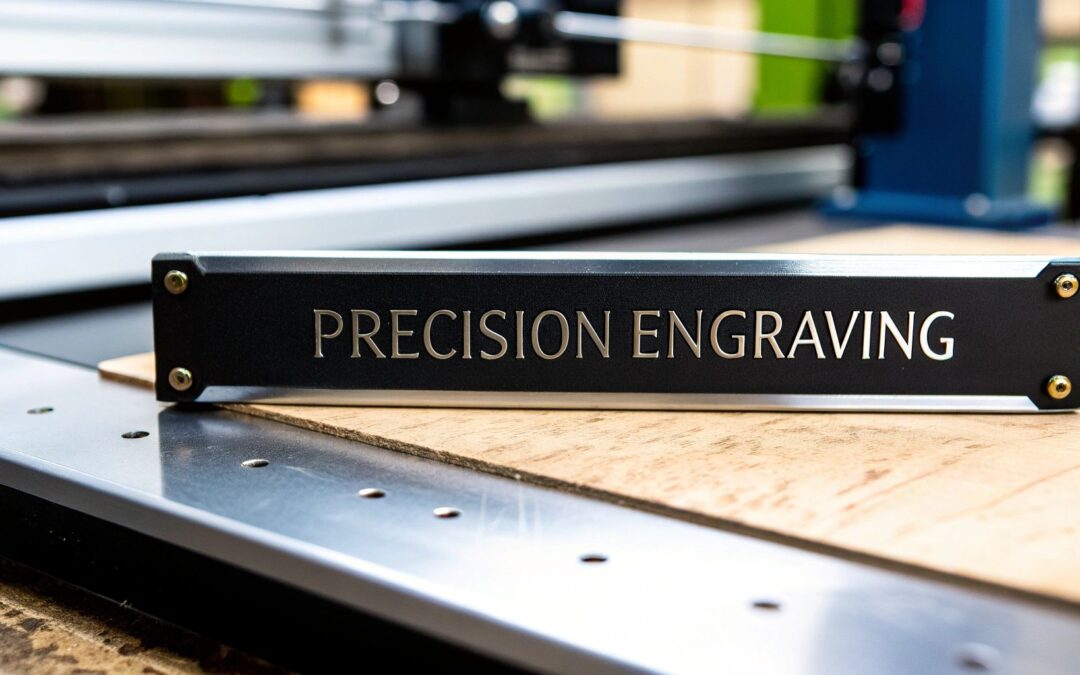
When you need a permanent mark that combines precision, artistry, and sheer durability, custom metal plaque engraving is the answer. It’s a process that uses advanced technology to create everything from highly detailed industrial labels to timeless memorial plaques, all with exceptional clarity and a lifespan that old methods just can't match.
Why Precision Engraving Matters for Your Metal Plaques
Welcome to the world of custom metal plaque engraving, where durability truly meets artistry. For industries as diverse as manufacturing, healthcare, infrastructure, and memorialisation, high-quality, laser-engraved plaques are absolutely essential. When information needs to be clear, permanent, and perfectly accurate, the quality of the engraving process becomes critical.
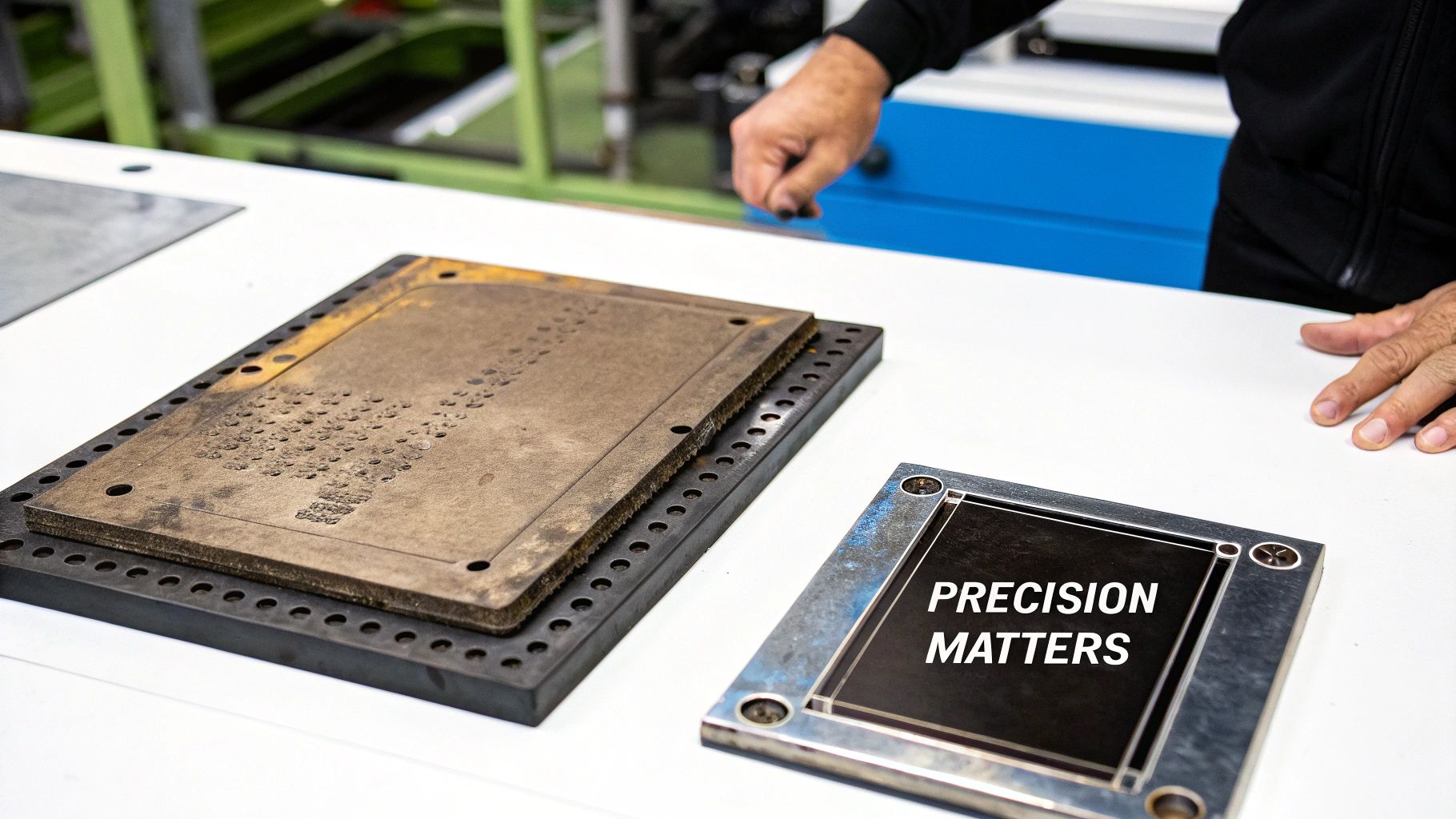
Older techniques like mechanical engraving often fall short. Not only can they introduce stress to the metal, but they also struggle to consistently reproduce fine details, complex logos, or small text. It's a slower, less versatile process that limits both the creative and functional possibilities for your project.
The Superiority of Laser Technology
Modern laser technology is a far more effective solution. Using our state-of-the-art Trotec Laser machines, the process is non-contact, which protects the integrity of the metal while delivering incredibly fine detail. Think of it as the difference between using a blunt chisel and a surgeon’s scalpel; the laser gives us an accuracy that is simply unmatched.
This level of precision ensures that every detail, from a schematic diagram on an industrial control panel to the delicate script on a commemorative plaque, is rendered perfectly. The benefits are clear:
- Unmatched Detail: We can reproduce intricate designs and tiny fonts with perfect clarity.
- Permanent Marking: The engraving becomes a permanent part of the metal itself, so it’s resistant to fading, wear, and tough environmental factors.
- Material Integrity: Because the process is non-contact, it avoids causing any stress or damage to the plaque's surface.
At Evright, your digital design is fed directly into our state-of-the-art Trotec laser system. Guided by computer precision, the laser beam alters the metal's surface to create a permanent, high-contrast mark that looks exactly as you envisioned. It’s a seamless blend of artistry and engineering that ensures a perfect result, every single time. Learn more about our process at evright.com.
This guide is your roadmap to understanding the materials, the engraving process, and the design considerations you’ll need to think about. We want to empower you to make informed decisions for your specific needs.
Choosing the Right Metal for Your Engraved Plaque
Picking the right material is the first, and most important, step in creating a plaque that not only looks great but will actually last. The metal you choose is going to dictate everything from durability and looks to its overall performance out in the field.
This isn't just about appearances; it's a practical decision that guarantees your plaque remains legible and intact for years to come. You need to think about real-world conditions. Will it be exposed to moisture, chemicals, harsh sunlight, or physical knocks? The answers will point you straight to the perfect material for your custom metal plaque engraving.
Stainless Steel: The Industrial Powerhouse
When you absolutely cannot compromise on resilience, stainless steel is the undisputed champion. Think of it as a fortress for your information, specifically engineered to shrug off the most demanding conditions. Its built-in strength and incredible resistance to corrosion make it the obvious choice for heavy-duty industrial jobs.
You’ve got two main grades to consider:
- Grade 304: This is your excellent all-rounder. It’s perfect for general industrial use, factory floors, and any indoor application where you just need something tough.
- Grade 316 (Marine Grade): This is the next level up. It contains molybdenum, an element that gives it superior resistance to the chlorides you find in saltwater and de-icing salts. If your plaque is going anywhere near the coast, in a marine environment, or in a chemical processing plant, Grade 316 is essential.
Stainless steel’s clean, modern finish also provides a fantastic high-contrast background for laser engraving, making sure that critical data, safety warnings, and asset tags stay sharp and readable forever.
Aluminium: Lightweight and Versatile
Aluminium gives you a brilliant mix of durability and lightweight properties, which makes it an incredibly flexible option. It’s the agile athlete of the metal world—strong and capable, but light on its feet. This makes it a fantastic fit for applications where weight is a real concern, like on equipment panels, inside vehicles, or for large signs that need to be installed easily.
Anodised aluminium is especially popular for custom plaques. The anodising process creates a tough, protective outer layer that ramps up its resistance to scratches and wear. Better yet, it allows for a whole range of vibrant colour options. When we hit it with a Trotec laser, the beam cleanly vaporises that coloured layer to reveal the bright, natural aluminium underneath, creating a striking and permanent mark.
Brass: The Classic Choice for Prestige
For those times when you need to convey a sense of tradition, elegance, and importance, brass is the timeless answer. Its warm, golden glow has a classic aesthetic that’s perfect for awards, memorial plaques, historical markers, and professional office nameplates. A beautifully engraved brass plaque simply makes a statement of quality.
Now, brass will naturally develop a rich patina over time when it's exposed to the elements—a look many people actually want for that vintage feel. But if you want to keep it looking brilliant and shiny for indoor use, it can be treated with a protective lacquer. Laser engraving on brass produces incredibly clean, sharp text and detailed logos with a dark, contrasting finish that is both beautiful and easy to read.
To help you decide, here’s a quick breakdown of the key differences between these popular metals.
Metal Plaque Material Comparison Guide
This table compares the key characteristics of common metals used for custom plaque engraving to help you select the best material for your application.
| Metal Type | Best For | Durability Rating | Corrosion Resistance | Aesthetic Finish |
|---|---|---|---|---|
| Stainless Steel (316) | Harsh industrial, marine, and outdoor environments | Very High | Excellent | Modern, brushed/polished silver |
| Stainless Steel (304) | General industrial, indoor, and high-traffic areas | High | Very Good | Modern, brushed/polished silver |
| Anodised Aluminium | Lightweight applications, equipment tags, colourful signage | Medium-High | Good | Matte or satin finish in various colours |
| Brass | Prestige awards, memorial plaques, historical markers | Medium | Fair (develops patina) | Classic, polished gold (can be lacquered) |
Ultimately, your choice comes down to balancing the demands of the environment with the final look you want to achieve. Each metal has a role to play, from the industrial muscle of stainless steel to the timeless elegance of brass.
The need for precise and permanent marking is growing fast. Here in Australia's industrial scene, the laser marking market—which includes custom metal plaque engraving—is set to grow at a compound annual rate of 8.6% from 2025 to 2031. This growth is being fuelled by key sectors like automotive and aerospace, where accurate engraving is absolutely critical for everything from asset labelling to compliance.
How Precision Laser Engraving Technology Works
To really appreciate the quality of a custom metal plaque, it helps to understand the technology we use to create such a flawless, permanent mark. The magic behind it all is precision laser engraving, a process that leaves older, more aggressive methods in the dust. Forget the brute force of mechanical tools; this is a modern, refined technique.
Think of it like a digital chisel, impossibly sharp and guided by a computer, using a focused beam of light instead of a physical blade. That’s the core concept. It's a non-contact process, which means it permanently alters the metal's surface without applying any mechanical stress. This is crucial because it ensures the plaque remains perfectly flat and structurally sound.
The Science of a Flawless Mark
Unlike traditional methods that physically carve or stamp into the material, a laser beam works with pinpoint accuracy. It delivers a concentrated burst of energy to a tiny spot on the metal's surface. This intense energy either vaporises a minuscule layer of the material or changes its surface properties, creating a high-contrast, permanent mark that won't fade or peel.
This process gives us some clear advantages over older techniques like chemical etching or mechanical engraving:
- Unmatched Precision: The laser can create incredibly fine text, complex logos, and detailed schematics that would be impossible with a physical tool.
- No Material Stress: Because nothing physically touches the plaque, there’s no risk of warping, bending, or creating weak points in the metal.
- Superior Speed: The computer-guided laser moves with incredible speed and efficiency, making it ideal for both one-off projects and large production runs.
At Evright Industrial, we rely on the advanced capabilities of Trotec Laser machines to get these results. These systems are renowned for their ability to produce consistently crisp, clean marks that are designed to last a lifetime, even in the most demanding Australian conditions.
This infographic gives you a simple overview of how material choice lines up with the intended application—a key first step in any engraving project.
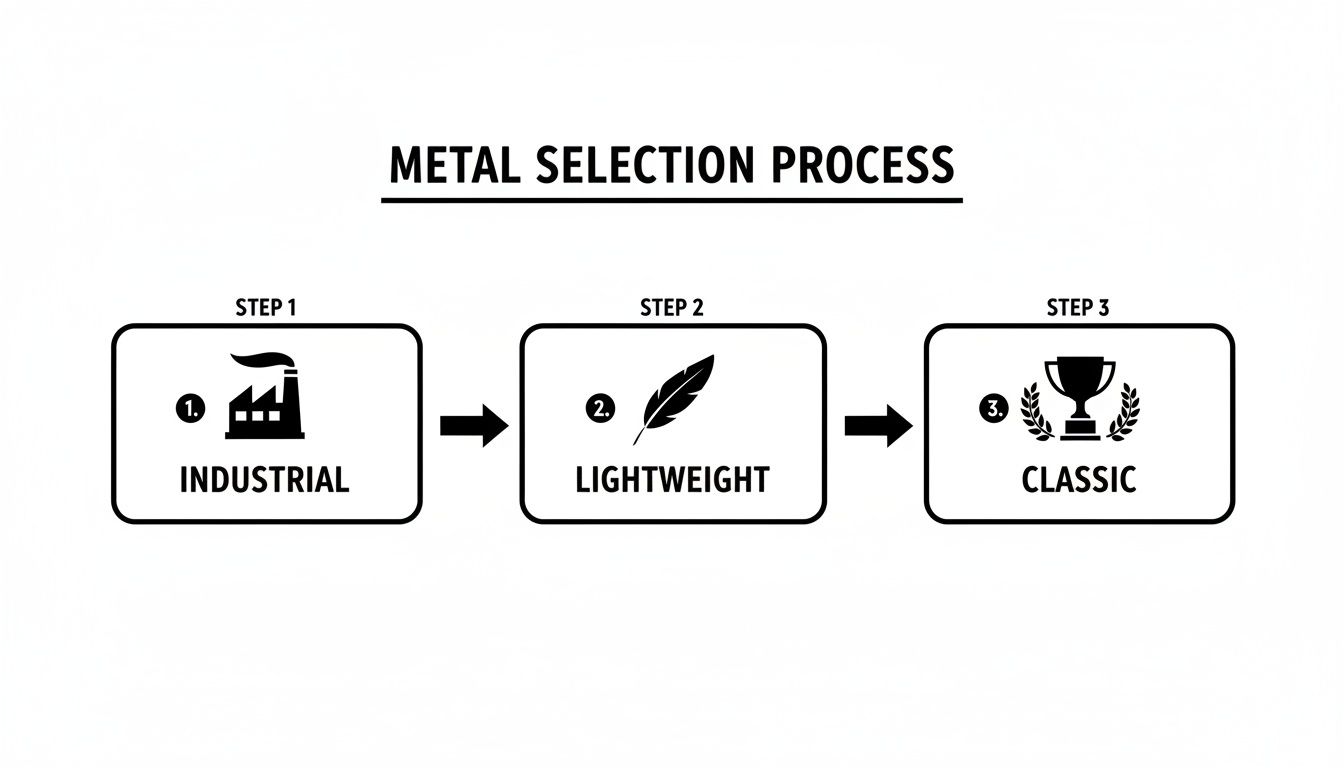
The visual flow highlights how selecting the right metal—be it for heavy-duty industrial, versatile lightweight, or prestigious classic needs—is foundational to a successful outcome.
Our Process From Design to Reality
Getting from a digital file to a finished metal plaque is a seamless integration of design and technology. The entire workflow is controlled by specialised software that ensures absolute fidelity to the original artwork. This guarantees that what you see on the screen is exactly what you get on the metal.
This level of control is what makes professional custom metal plaque engraving so reliable and consistent.
At Evright, your digital design is fed into our state-of-the-art Trotec laser system. The laser beam, guided by computer precision, vaporises or alters the metal's surface to create a permanent, high-contrast mark exactly as you envisioned. It's a blend of artistry and engineering that ensures a perfect result every time.
This meticulous, software-driven process removes the potential for human error that comes with manual methods. Every line is perfectly straight, every curve is flawlessly smooth, and every character is rendered with exceptional clarity.
To see how this technology applies to different materials, you can learn more about our specific work with laser engraving on metal and how we adapt the process for stainless steel, aluminium, and brass. The technology isn't just about making marks; it's about delivering certainty and quality with every single plaque we produce.
Preparing Your Artwork for Flawless Engraving
A world-class plaque begins long before the laser even touches the metal; it all starts with a meticulously prepared design file. Getting the artwork right from the get-go is the single most important step to ensure your vision translates perfectly onto the finished product, saving everyone time and avoiding costly revisions down the track.
Think of your artwork file as the blueprint for our advanced Trotec Laser machines. Just like a builder needs a precise architectural plan to construct a building, our equipment requires clean, accurate data to produce a flawless result for your custom metal plaque.
Why Vector Files Are the Gold Standard
The most critical element for a crisp, sharp engraving is the type of file you send us. In the world of digital images, there are two main players: raster and vector. While they both have their place, only one is cut out for the precision of engraving.
- Raster Images (.JPG, .PNG, .GIF): These are essentially digital photos, made up of a grid of tiny coloured squares called pixels. They look great at their intended size, but the moment you try to enlarge them, they become blurry and jagged. The pixels just get bigger, and all that sharp detail is lost.
- Vector Files (.AI, .EPS, .SVG): Instead of pixels, vectors are built from mathematical equations that define lines, points, and curves. Think of it less like a static picture and more like a set of instructions. This means they can be scaled to any size—from a tiny tag to a massive building sign—without ever losing quality. The lines will always stay perfectly crisp.
For this reason, vector files are the undisputed gold standard for laser engraving. They give our Trotec laser systems the clean, scalable data needed to create incredibly precise, high-definition marks every single time.
Essential Artwork Preparation Steps
Once you have your design in a vector format, running through a few simple checks will guarantee a smooth production process. Taking care of these details beforehand helps us get your project underway without any hitches or delays.
Convert Text to Outlines: Fonts are technically little pieces of software on your computer. If we don't have the exact same font file installed on our system, your carefully chosen text won't show up correctly on our end. The simple fix is to convert your text to outlines (sometimes called 'curves'). This process turns the letters from editable text into fixed vector shapes, locking them in place so they engrave exactly as you intended.
Choose Legible Fonts: While elaborate, decorative scripts can look beautiful on screen, they often don’t translate well when engraved on metal, especially at smaller sizes. For maximum legibility on things like industrial tags and compliance plates, it's best to opt for clear, sans-serif fonts like Arial, Helvetica, or Franklin Gothic. Of course, getting the wording right is just as important. For some great ideas on tone and clarity, you can explore these memorial plaque wording examples.
Specify Physical Details: Your artwork file is the perfect place to communicate all the final specifications for your plaque. Including these details ensures nothing gets missed in translation.
Your design file should be more than just the graphics; it should be a complete instruction manual for your plaque. Including details like mounting holes, corner radius, and overall dimensions directly in the file eliminates guesswork and ensures total accuracy.
Be sure to clearly mark out:
- Plaque Size: The exact height and width of the final piece.
- Corner Style: Do you want sharp 90-degree corners, or rounded corners with a specific radius?
- Mounting Options: Indicate the precise location and diameter of any pre-drilled holes for screws. If you need an adhesive backing instead, make a note of that too.
By providing a well-prepared vector file with all these details included, you empower our team to create a perfect custom metal plaque that matches your vision exactly.
Where Custom Metal Plaques Really Shine
Let's move past the technical details and look at where the rubber really hits the road. The true measure of a custom metal plaque isn't just its material, but how it performs out in the real world, solving critical problems across different industries.
These aren't just fancy labels. From a hectic factory floor to a quiet hospital wing, a well-made plaque is a vital part of the day-to-day operation, keeping people safe, assets tracked, and information clear.
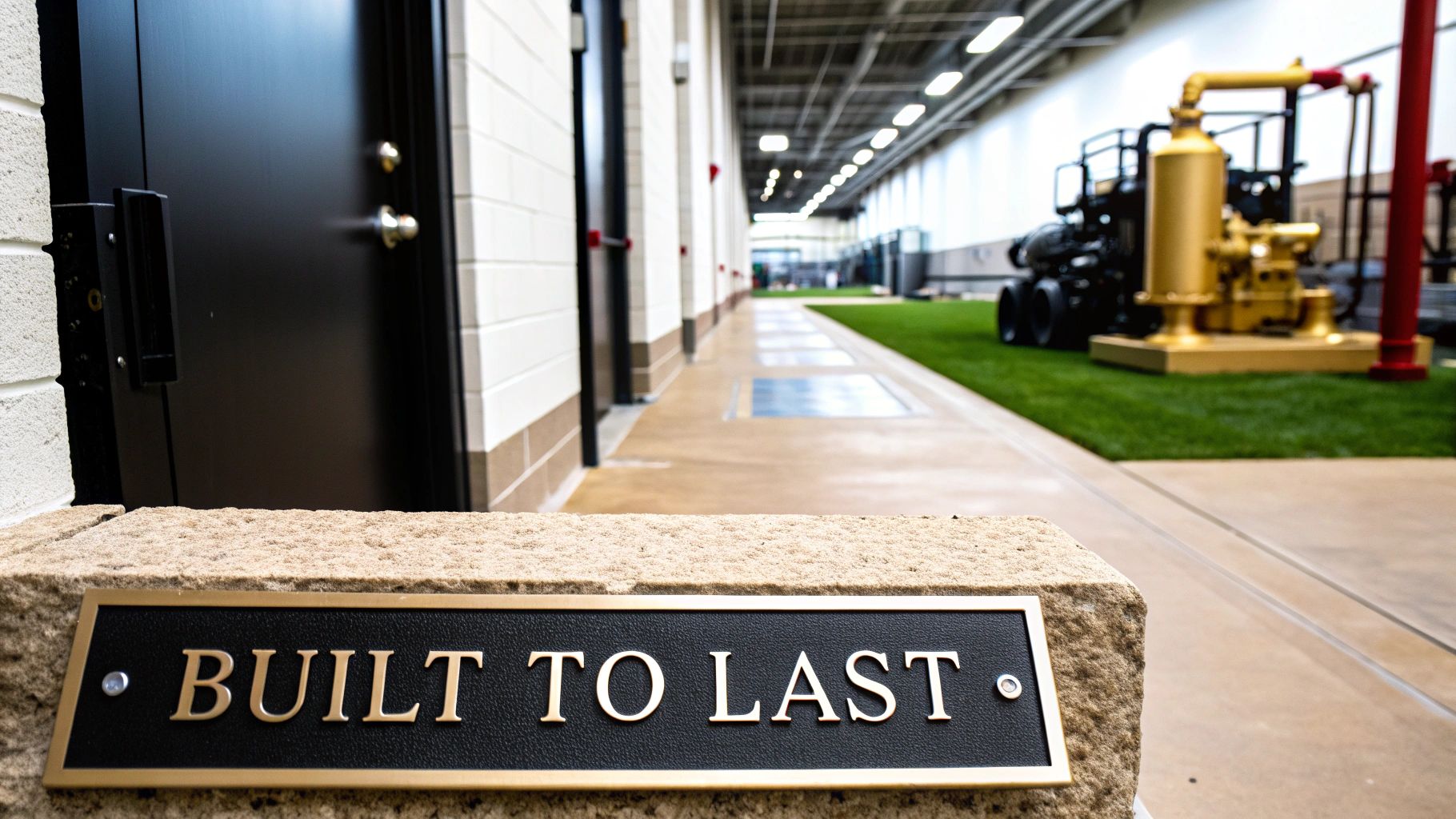
Each environment presents its own unique challenges, demanding a specific blend of material, design, and engraving to meet industry standards.
Manufacturing and Heavy Industry
In the tough, unforgiving world of manufacturing, plaques are constantly up against grease, high heat, and physical knocks. Durability isn't just a nice-to-have; it's non-negotiable. This is where stainless steel, engraved with a high-powered Trotec Laser, becomes the go-to choice for its sheer resilience.
You'll find them everywhere:
- Machinery Control Panels: Think of the vital instructions and safety warnings on a piece of heavy equipment. These markings have to be perfectly legible and can never fade or wear away, no matter how many times they're wiped down or used.
- Asset Tags and VIN Plates: Permanently etched serial numbers, barcodes, and QR codes are the backbone of modern inventory management. They provide a foolproof way to track valuable assets through their entire lifecycle.
- Compliance Plates: These plaques carry the critical data—load ratings, specs, and compliance details—that prove machinery is up to code. Laser engraving ensures this information is there to stay, permanently.
Healthcare and Medical Facilities
In any healthcare setting, cleanliness and clarity are paramount. Anything you bring into this environment has to be easy to sterilise and able to withstand harsh cleaning agents. That’s why 316-grade stainless steel is the industry standard. Precision engraving is also vital, as clear, accurate information can directly impact patient safety.
In a hospital, there is simply no room for error or ambiguity. Custom metal plaque engraving delivers sterile-safe, permanent identification for everything from surgical tools to wayfinding signs, all while meeting the most stringent hygiene protocols.
In these environments, plaques perform several key jobs:
- Sterile Equipment Identification: Laser-engraved tags on medical devices and surgical tools can handle countless cycles in an autoclave without degrading.
- Wayfinding Signage: In a large, complex hospital, clear and durable signs for wards, labs, and restricted areas are essential for helping staff and visitors find their way quickly and safely.
- Room and Door Plaques: Professional, easy-to-clean plaques are used to identify everything from patient rooms to consultation offices and specialised treatment areas.
Infrastructure and Public Works
When it comes to public infrastructure, plaques have to be built for the long haul. They need to stand up to decades of sun, rain, and fluctuating temperatures. This is where materials like anodised aluminium and marine-grade stainless steel really prove their worth. The deep, clean engraving from a Trotec laser guarantees the text will be just as readable in 20 years as it is today.
You’ll see them as warning signs on electrical substations, identification tags for underground cables, and markers for public utilities. The incredible longevity of these plaques cuts down on maintenance costs and ensures crucial public safety information stays visible.
Memorials and Commemorative Plaques
Finally, custom metal plaque engraving plays a deeply important and dignified role in remembering people and marking significant events. For a memorial plaque in a park, on the side of a building, or as part of a public artwork, the quality of the finish is everything.
Brass is a popular choice for its classic, warm look that develops a beautiful, distinguished patina over time. For a more modern and sleek feel, stainless steel provides a timeless, enduring alternative.
The incredible precision of Trotec laser technology means we can include fine text, intricate details, and even portraits, creating a lasting tribute that honours a legacy with the respect and permanence it truly deserves.
Your Guide to Ordering and Installation
So, you’ve got an idea for a custom metal plaque. Getting it from a concept in your head to a finished product on the wall is a pretty straightforward journey with us. We’ve set up our process to be clear and efficient, making sure you get exactly what you need without the headaches. It all kicks off with a simple request and ends with a durable, perfectly engraved plaque ready for its new home.
The first step is to get a quote. Just send us your design ideas, let us know what material you're thinking of, and how many you need. From there, we can give you a clear and accurate estimate. After that, we’ll have a design consultation where our team works with you to polish the artwork, lock in the specifications, and make sure every last detail is spot on before we even think about production.
From Proofing to Production
Once your design is finalised, we'll send over a digital proof for you to approve. This is your moment to give everything a final check – the layout, spelling, and all the technical specs. Your go-ahead is the green light for our skilled technicians to fire up the precision Trotec Laser machines and bring your project to life.
At this point, a few things can influence how long it'll take:
- Material Choice: Some metals, like specific grades of stainless steel, can take a bit longer to get our hands on than standard aluminium.
- Order Quantity: A single commemorative plaque will naturally be done and dusted faster than a run of 500 industrial asset tags.
- Design Complexity: Intricate logos or detailed schematics might need more setup and engraving time compared to a plaque with just simple text.
We’re big on transparency, so we'll always give you a realistic timeline right from the start. Our goal is to set clear expectations and get your project delivered right on schedule.
Installation and Long-Term Care
To keep your plaque looking sharp for years to come, a little care in how you install and maintain it goes a long way. Think about the surface you're mounting it on. For outdoor spots like brick or concrete, stainless steel screws are your best bet. For smooth, clean indoor surfaces like doors or walls, a strong adhesive backing often does the trick perfectly.
Keeping your plaque clean is simple. For stainless steel and aluminium, a gentle wipe with a soft, damp cloth is usually all it needs. Brass can be polished with a dedicated cleaner to keep its shine, or you can let it age naturally to develop that classic, distinguished patina over time.
This easy care routine ensures your custom metal plaque engraving remains a clear and lasting mark. At Evright, we use state-of-the-art Trotec Laser technology to create permanent, high-contrast marks on metal. To see how it all works and explore what we can do, you can learn more at evright.com.
Right, you've got a project in mind and a few questions about getting the perfect engraved metal plaque. That's completely normal. To help you move forward with confidence, we've put together answers to the most common queries we get from our clients.
Getting these details sorted out upfront makes the whole process smoother for everyone and ensures the final piece is exactly what you envisioned.
What Is the Most Durable Metal for an Outdoor Plaque in Australia?
For almost any outdoor spot in Australia, you can't go past 316 marine-grade stainless steel. It's the top choice for a reason. Its incredible resistance to corrosion, salt spray, and UV damage means your engraving will stay sharp and easy to read for decades, even in tough coastal or industrial settings.
While some people love the classic, aged look that bronze and brass develop over time, stainless steel is all about consistency. It holds its original finish with very little upkeep, giving you a clean, modern look that lasts.
Can You Engrave Complex Logos or Very Small Text?
Absolutely. This is where our advanced Trotec Laser engraving technology really shines. The laser beam is incredibly precise and guided by a computer, allowing us to replicate intricate logos, detailed graphics, and tiny text that older mechanical methods just can't handle.
A quick tip from our team: for the best possible result, send us your logo as a vector file (.ai or .eps). This format lets us scale your design perfectly without losing any of that crisp detail.
How Long Does It Take to Get a Custom Metal Plaque Made?
The turnaround time really depends on the specifics of your job. We need to consider the material you've chosen, how complex the engraving is, and the number of plaques you need. A simple, one-off plaque might only take a few business days, whereas a large batch of complex industrial tags will naturally take a bit longer.
The good news is, we're known for our efficient process here at Evright Industrial. Once we review your requirements, we'll give you a clear and realistic timeline along with your quote.
What Kind of File Format Do I Need for My Design?
To get that razor-sharp quality everyone wants, a vector format is always the best way to go. The ideal file types we work with are:
- .AI (Adobe Illustrator)
- .EPS (Encapsulated PostScript)
- .DXF (Drawing Exchange Format)
- A high-quality .PDF that still has the vector information intact
Vector files are fantastic because they let us resize your design to any dimension without it becoming blurry or pixelated. If you only have a standard image file like a .JPG or .PNG, don't worry – we can usually work with it, though our team might need to do a bit of design work to get it ready for engraving.
Here at Evright Industrial, we use top-of-the-line Trotec Laser technology to create permanent, high-contrast marks on all sorts of metals. To see how it all comes together and find out what we can do for your project, learn more at https://evrightindustrial.com.au.
Recent Comments